2012-06-27

Coupled heat capacity problem


A 25.78g block of Fe(s) at 47.15℃ is dropped into 100.0g of ethanol at 4.87℃. When the system reached thermal equilibrium, what is the temperature? Assume the system is perfectly insulated/isolated. Heat capacity of Fe(s) = 0.451J/g℃and of ethanol = 2.46J/g℃.

This is a “coupled systems” problem. The “hot” Fe(s) will lose energy/heat that will be absorbed by the “cold” ethanol. Qualitatively, the final temperature must be less than 47.15℃ and greater than 4.87℃, given the relative amounts and properties of Fe(s) and ethanol, it's reasonable to assume that the final temperature will be closer the 4.87℃ than 47.15℃. Because the system is “perfectly insulated”, all of the energy lost by the Fe(s) will be gained by the ethanol. So the energy picture is:
Eout(from Fe(s)) = (0.451J/g℃)(25.78g)(Tf – 47.15℃)
Ein(to ethanol) = (2.46J/g℃)(100.0g)(Tf – 4.87℃)
Let's look at 2 ways to treat this, one is more rigorously mathematical, the other in still mathematical, but involves a little hand-waving. You can decide which is which...
Using the equations as written above, we have a “frame of reference” problem. Eout should equal Ein, but in order to do the straight-up algebra, we need to approach the problem from a single frame of reference. What does this mean? The short answer? Sneak a little negative sign into the equation. The effect of this will be to change the frame of reference of one of these energies so that they're both the same. Then it's an algebra problem to solve for Tf:
- (0.451J/g℃)(25.78g)(Tf– 47.15℃) = (2.46J/g℃)(100.0g)(Tf– 4.87℃)
For simplicity's sake, I know that all of the units are going to cancel (except for the final ℃), so I'm going to drop them. Let's bunch all of the constants together...
(-0.04726)(Tf – 47.15℃) = (Tf – 4.87℃)
Distributing the constant...
-0.04726Tf + 2.22847 = Tf – 4.87
Grouping “Tf” terms and number terms...
2.22847 + 4.87 = (1 + 0.04726)Tf
7.098 = 1.04726Tf
And the final step gives...
Tf = 6.78℃
If we'd rather treat this as a “magnitude of energy” problem, then we don't have to mess around with adding a negative sign. We can do this by using the absolute value of the change in temperature. Do you have an “absolute value” button on your calculator? I don't think I do... Fortunately, this is a real-world problem, so we can use a little intuition to make thing behave. Since Tfis greater than 4.87, the (Tf– 4.87℃) term will be positive, so the absolute value takes care of itself. The other temperature change, (Tf– 47.15℃), will be negative {since we know that Tfis less than 47.15}, so the absolute value of this term will be... (47.15℃ – Tf). Now we can plug in and once again solve:
(0.451J/g℃)(25.78g)(47.15℃ – Tf) = (2.46J/g℃)(100.0g)(Tf– 4.87℃)
(0.04726)(47.15℃ – Tf) = (Tf – 4.87℃)
2.22847 – 0.04726Tf = Tf – 4.87℃
2.22847 + 4.87 = (1 + 0.04726)Tf
7.098 = 1.04726Tf
Tf = 6.78℃
Same result either way.

2012-06-26

Polyatomic ions

You should know the following polyatomic ions:
Nitrate (NO3-1), sulfate (SO4-2), carbonate (CO3-2), phosphate (PO4-3), chlorate (ClO3-1), bromate (BrO3-1), iodate (IO3-1), hydroxide (OH-1), cyanide (CN-1), cyanate (OCN-1), thiocyanate (SCN-1), thiosulfate (S2O3-2), permanganate (MnO4-1), chromate (CrO4-2), dichromate (Cr2O7-2), ammonium (NH4+1)
Notice that when "thio" appears in the name, it often means that one of the oxygens has been replaced by a sulfur.
In a couple weeks we'll be looking at acids and bases, and a number of these polyatomic ions can be protonated to form additional polyatomic ions that you should also know such as:
bicarbonate/hydrogen carbonate (HCO3-1), bisulfate/hydrogensulfate (HSO4-1), hydrogen phosphate (HPO4-2), dihydrogen phosphate (H2PO4-1)
Oxoanions are systematically named using suffixes and prefixes, so you should be able to determine formulas/names for the full family of an oxoanion. Let's look at the chlorine family as an example... chlorATE is ClO3-1. If we add an oxygen to chlorate but keep the same charge, we get PERchlorATE, ClO4-1. If we remove an oxygen from chlorate but keep the same charge, we get chlorITE, ClO2-1. If we remove another oxygen but keep the same charge, we get HYPOchlorITE, ClO-1. If you know all the "-ate" versions of the oxoanions, you should be able to get the rest of them.


2012-06-24

Welcome to Summer 2012!

Welcome to Gen Chem II (CHEM 210) for Summer 2012. We've got a tight 5-week schedule and a lot of material to cover. I'll try to post blog and/or twitter updates every day, but with the pace of the class I may miss a day or two. Look back over blog posts from January-May 2012 for info. If you're on Twitter, I'll be tweeting about class with #GenChem2012. See you bright and early!

2012-05-10

Grades posted

Grades for my CHEM 210 and 210L classes are posted on eServices.  Let me know if you have any questions and have a great summer.

2012-05-01

Exam keys all posted

I had a little technical "oops", all of this semester's Gen Chem II exams and keys are now posted. http://www.drbodwin.com/teaching/jbgenchem.html

A few people have asked about what equations and/or other information will be provided with the exam.  I cannot show you the exact information sheet that will be on the exam, but it is not all that different from the front page information you get with the exams you have taken (look at page 1 of Exam 4).  The ACS exam doesn't include everything I do, and it has a few things that I don't, but the big equations/formulas/constants are all there.

2012-04-28

Exams and keys posted

This year's Gen Chem II exams and (some of) the keys are posted at http://www.drbodwin.com/teaching/jbgenchem.html .  I'll try to get all the keys posted tomorrow.

2012-04-27

Standardized Final Exam

Your final exam will be a standardized American Chemical Society exam.  I know a number of you are a little anxious about this, but there are a few things to remember:
1. "Standardized" does not mean "impossible unless you're a genius".  "Standardized" just means that there are national averages to which your score can be compared.  This allows your performance to be scaled to Gen Chem students at any other school.
2. If I've done my job, I have helped you learn all the fundamental material in General Chemistry.  I certainly hope that I'm giving you as good an education in General Chemistry as you would get at any other university, in fact, I would hope that I'm giving you a better Gen Chem education than you would get at most other universities.  By occasionally using a standardized exam, I can see what things I'm doing well and what areas I need to improve to give future Gen Chem students the best possible education.
3. The format and length might vary slightly, but expect 70 questions and a 110 minute time limit.  That's almost 2 hours, and 1.5 minutes per question.  Some questions will be quicker than others, but at 1.5 minutes per question, none of them can be huge.  Many of the questions on my exams are probably 10-20 minute questions by the time you work through all the parts, none of the questions on the ACS exam will be anywhere near that complex.
4. 70 questions means that each question is worth XX% of the total score. {I'll leave the calculation of "XX" for you to do as a practice math problem.}  Scaling that to 200pts (the value of your final exam), means that each question would only be worth YYpts if I plugged your scores directly into my grade sheet.  {Again, "YY" is a practice math problem...}  On my exams, if you totally miss one of the big questions, you lose ~10%, sometimes more.  Yikes.
5. It is quite unlikely that I will plug your scores directly into my grade sheet, I will almost certainly be using some sort of scaling formula to calculate a score out of 200 points.  That doesn't mean you shouldn't prepare well for the exam, a good score can really help and a poor score can definitely hurt your final score/grade in the class.
6. There are resources available for you to use as practice.  The actual ACS Gen Chem exams are not published, BUT every year the ACS prepares exams for the Chemistry Olympiad for high school students.  These are not identical to the ACS Gen Chem exam, but the questions are similar and the style/format is almost the same.  The ACS posts their old Chemistry Olympiad exams online, so you can look them over to help you prepare.  Check out:  http://www.acs.org/content/acs/en/education/students/highschool/olympiad/pastexams.html for 10+ years of previous Chemistry Olympiad exams from both the local and national level competition.

Good luck in your preparation.

2012-04-18

Redox lab question

Quite a few people have questions about the redox lab, so let me give a hint/some guidance to everyone...

In the first part, you looked at reactivity and found Zn to be the most active metal, followed by Pb, then Cu.  I'll just use those three as an example, you will also need to include Ni and Ag in your assignment.  You measured the potential for a Zn/Pb cell, a Pb/Cu cell, and a Zn/Cu cell.  Is there a relationship between those measured potentials?  There's a relationship between those reactions, but how are cell potentials related to one another?
Zn(s) + Pb2+(aq)  ⇄  Pb(s) + Zn2+(aq)
Pb(s) + Cu2+(aq)  ⇄  Cu(s) + Pb2+(aq)
Zn(s) + Cu2+(aq)  ⇄  Cu(s) + Zn2+(aq)
Are cell potentials like kinetics (the cell potential for the overall process is determined by the lowest potential)?  Are cell potentials like equilibrium (the cell potential for the overall process is the product of the step-wise potentials)?  Or is there another relationship between the step-wise potentials and the overall potential?  When you think you see (observe) a relationship with the Zn/Pb/Cu system (hypothesis), check to see if the same relationship is true with some of the other cell combinations you measured.(test/experiment)

{Hmm, it looks like we could use the scientific method to analyze the data and results from this experiment.  Who would have guessed?!}

On your hand-in assignment for lab, the "calculated" cell potentials for pairs that are not next to each other refers to the treatment you see above.  You have measured all of the potentials for cell constructed from metals that are adjacent to each other in your activity series (step-wise potentials), so if there is a relationship between step-wise potentials and the potentials for cells constructed from metals that are not adjacent to each other in your activity series, you should be able to calculate the expected cell potential for those non-adjacent cells.

2012-04-12

Voltaic Cells

Not a lot of information right now, but I just finished drawing a voltaic cell diagram.  Not perfect, but I'm pretty satisfied with it.

2012-04-10

Balancing Redox Reactions


Balancing redox reactions can be pretty simple for some system, but some redox reactions can be exceptionally challenging. To balance any redox reaction, we can follow a systematic set of steps, and every Gen Chem book happily provides a set of steps. In my experience, most books use rules that require a little bit of faith and function like a black-box. There are a LOT of places that mistakes can be made when balancing redox reactions, so I prefer to use rules that have built-in places to check my answer before I go through the whole process. Here they are:

Balancing redox rules (in acidic or neutral aqueous solutions):
1. Assign oxidation numbers to all atoms in the equation
2. Identify the oxidation and reduction half reaction
3. In each half reaction, balance all atoms except hydrogen and oxygen
4. In each half reaction, add electrons to the reactant or product side to balance the change in oxidation state. Note: you are not adding electrons to balance charge
5. In each half reaction, add water molecules to balance any oxygen atoms
6. In each half reaction, add H+(aq) to balance any hydrogen atoms
7. At this point, the half reactions should be balanced, check the charge balance to confirm
8. Multiply each half reaction by an appropriate integer to balance the electrons involved in the oxidation and reduction processes
9. Add the half reactions together
10. Again, the resulting reaction should be balanced, check the charge balance to confirm
11. Cancel out any spectator species, sit back and pat yourself on the back for writing such a lovely balanced redox equation.
These rules work well, BUT rely upon some assumptions. First, since we're using water and H+(aq), the reaction must be taking place in aqueous solution that is neutral or acidic. That's OK for most redox reactions in Gen Chem, but once in a while we'll run into a rxn that takes place in basicaqueous solution. How do we handle that? Think about it... basic solutions have excess (relatively speaking) hydroxide ions. Hydroxide ions react with H+(aq) ions to form water. If a reaction is taking place in basic aqueous solution, balance it according to the above rules and then add:
12. Add enough OH-1(aq) to each side to react with all the H+(aq) that is present
13. Check charge balance
14. Cancel any excess water
As with any process, practice is the key, so practice balancing redox rxns, then practice a little more, and when you think you have it all figured out, practice a couple more times. We'll do some of that in class...

2012-04-06

Oxidation Numbers

Oxidation numbers describe the balance between electrons and protons on an atom, whether that atom is happily floating around all by itself or part of a massive molecule. Oxidation numbers can be determined two different ways: by using rules, or by looking at structure. Let's look at the rules first.
Oxidation Numbers by the Rules:
1. For neutral, uncombined elements, Ox# = 0. Examples: Fe(s), H2(g), Hg(l), Ne(g)
2. For monoatomic ions, Ox# = charge. Examples: Fe2+(aq) {Ox# = +2}, P3-(g) {Ox# = -3}
3. Oxygen is almost always Ox# = -2, except in O2 {Ox# = 0, Rule #1} and peroxides {Ox# = -1}
4. Hydrogen is almost always Ox# = +1, except in H2 {Ox# = 0, Rule #1} and hydrides {Ox# = -1}
5. The sum of the Ox#s on all the atoms in a polyatomic molecule or ion is equal to the charge on the whole polyatomic molecule or ion.
Let's look at a redox reaction and assign Ox#s by the rules:
Cl2(g) + 2 O2(g) 2 ClO2(g)
Cl2(g) : Rule #1, Ox# = 0
O2(g) : Rule #1, Ox# = 0
ClO2(g) : Rule #3, oxygen is Ox# = -2.
ClO2(g) : Rule #5, (Ox# Cl) + 2(Ox# O) = 0 (the charge on a neutral molecule)
(Ox# Cl) + 2(-2) = 0
(Ox# Cl) = +4
So in this redox reaction, each Cl is going from 0 to +4, losing 4 electrons, Losing Electrons is Oxidation; and each O is going from 0 to -2, gaining 2 electrons, Gaining Electrons is Reduction.

For many substances, it's actually easier to assign Ox#s by looking at the structure. The process is very similar to finding Formal Charge, the electrons are just assigned a little differently. Formal Charge assigns electrons as if all bonds are purely covalent, meaning that all bonding pairs of electrons are split with one electron given to each atom in the bond. Oxidation Number assigns electrons as if all bonds are purely ionic, meaning that all of the bonding electrons go to the more electronegative element in the bond.
Oxidation Number by the Structure:
1. Draw a good Lewis Structure
2. Assign all bonding electrons to the more electronegative element in the bond
3. Compare the electrons assigned to each atom to the valence electrons of the neutral element
Again, let's look at an example, in fact, let's look at the sameexample as above, ClO2(g). Drawing a good Lewis Structure:
This is a very interesting molecule, it violates the octet rule andit has an unpaired electron. Looks like it would be pretty reactive. Looking at the electronegativities, oxygen is more electronegative than chlorine, so all of the bonding electrons will be assigned to oxygen, giving each oxygen 8 assigned electrons and the chlorine 3 assigned electrons.
Neutral oxygen has 6 valence electrons, we've assigned 8 electrons to oxygen, so the oxidation number for oxygen in this molecule is -2, just like we predicted using the rules. Neutral chlorine has 7 valence electrons, we've assigned 3 electrons to chlorine, so the oxidation number for chlorine in this molecule is +4, again, just like we predicted using the rules. Both methods work. Why would you ever use structures when the rules work? Try looking at hydrogen peroxide, H-O-O-H, or a more complex molecule like glucose. The rules don't always give the best picture of what's happening in a molecule, and this can ultimately make it harder to predict reactivity or other behaviors.

Redox - Definitions


If you want to understand chemistry, you have to follow the electrons. If electrons are transferred during a chemical reaction (as opposed to just being rearranged...), then a reduction-oxidation process is taking place. To help keeping track of the electron transfer in redox processes, we can use a couple acronyms/mnemonics related to the definitions of reduction and oxidation.
OIL / RIG - “Oxidation Is Losing electrons” / “Reduction Is Gaining electrons”
LEO / GER - “Losing Electrons is Oxidation” / “Gaining Electrons is Reduction”
Hmm, why is “reduction” associated with gainingelectrons? Remember, electrons are negatively charged, so gaining electrons increases the number of negatively charged particles associated with an atom which reduces its net charge. But are we really looking at “charge” to determine redox chemistry? Sometimes it seems like it, but other times the charge doesn't seem to line up with the processes. We really have to look at oxidation number, which is related to charge, but a with some subtle differences. One way to distinguish charge and oxidation number is that “charge” can be used to describe the net overall balance between electrons and protons in a system that might contain multiple atoms, but “oxidation number” describes the balance between electrons and protons for each individual atom in a structure regardless of its size. Oxidation numbers sound important enough for their own post, look for it soon.
Another thing that can cause some mix-ups is the term “oxidation” or {in verb form} “oxidize”. {Or for the British English spellers in the crowd, “oxidise”.} The element oxygen is very often involved in redox reactions. Is oxygen usually undergoing oxidation or reduction? You know you want to say oxidation, the words look so similar... But if we start with molecular oxygen, O2(g), it's almost always going to gainelectrons. Gaining Electrons is Reduction. GER, indeed! The important thing to remember here is that reduction and oxidation are ALWAYS coupled processes. You can't have one without the other. This leads to some other terminology...
The process of one substance undergoing oxidation causes something else in the system to be reduced. The substance that is being oxidized is the reducing agent or reductant because it is causing reduction to take place.
The process of one substance undergoing reduction causes something else in the system to be oxidized. The substance that is being reduced is the oxidizing agentor oxidant because it is causing oxidation to take place.
So if oxygen is usually being reduced, it is a good oxidizing agent.


2012-04-04

Qualitative Analysis of Metal Cations - Week 2

This week in lab you're going to be analyzing an unknown mixture of the metal cations you studied last week.  To do this, you need to look over the tests you did last week and find a way to sequentially use some or all of those tests to separate the cations.  This is NOT a "run all the tests and figure it out later" experiment, you have to have a plan.
To develop your plan, assume you are starting with a mixture of all 5 cations, and you want to separate them into 5 different containers.  The key to developing a good flow chart is the ability to separate solids from each other when multiple things precipitate.  For example, if the first step of your flow chart is "add chromate", you will precipitate all 5 cations as their chromate salts.  You have no way to separate these solids from each other, so this would be a VERY bad first step.  Look over some of the multi-step tests you did last week.  If adding some reagent causes 2 or 3 of the cations to form precipitate, and you have a way to separate those precipitates from each other (with another step in the multi-step test you performed last week), then that might be a good place to start.
As an example, what if you had a mixture of NaCl, NaNO3, sand, and sawdust.  How could you separate them?  If you added water, the NaCl and NaNO3 would dissolve, the sand would sink, and the sawdust would float.  That accomplishes some of the separation, but what about the dissolved salts?  If there was a reagent you could add to make chloride ions form a precipitate, like maybe Pb2+(aq), you would be able to separate the chloride from the nitrate.
{OK, picky people in the crowd, that doesn't exactly separate "NaCl" from "NaNO3", but it illustrates the point!}
Given the tests you performed, there are a few different flow charts that will work to separate the 5 cations you're working with, so if you have something that's a little different from someone else, that's OK.  It would be great if you compared your flowchart to someone else's and had a discussion about the similarities and differences, it might lead you BOTH to make better flowcharts/plans.

2012-03-20

Titrations I - Monoprotic/Monoprotic


When we're dealing with acid-base chemistry, we have to be able to determine the concentration of the acids and bases that we're using. This most often means performing a titration where one of the components is known. The absolutely 100% most important thing about titrations is to remember that titrations are stoichiometryproblems, and they should be treated as such. There's nothing new and magical about titrations, they're just stoichiometry problems applied to a specific situation. The 4 steps to solve every stoichiometry problem are:
1) Write a balanced chemical equation
2) Calculate moles of one component (“moles of known”)
3) Convert moles of known to moles of interest using the ratios in the balanced chemical equation
4) Convert moles of interest to whatever you want to find
With acid-base titrations, it is most often convenient to monitor pH of the solution. To explore the pH-dependence of a titration, we can look at a system where we know all the concentrations. Let's say we are titrating 25.00mL of 0.85M nitrous acid, HNO2(aq), with 0.85M KOH(aq). At the beginning, we have a solution of a weak acid, so we can calculate the initial pH using a Kaexpression. Looking up the Kaof nitrous acid online gives a couple different values, let's say that it's around 5x10⁻⁴ . Kais just like every other equilibrium, so let's set up a table...

HNO2(aq) +
H2O(l)
H3O+(aq) +
NO2-1(aq)
[ ]initial
0.85M
XXXX
10-7 M
0 M
Δ [ ]
- x M
XXXX
+ x M
+ x M
[ ]equilibrium
(0.85 – x) M
XXXX
(10-7 + x) M
x M
Plugging in values:
That expression is solvable by the quadratic formula (and I encourage you to solve it for practice and to convince yourself that the things we're about to do are valid), but we might be able to simplify it if we make some assumptions about the size of “x”. Since this is a weak acid (Ka< 1), it's probably reasonable to assume that most of the HNO2molecules will still be intact when this system reaches equilibrium, so although we will lose some (Δ[ ] = -x), the value of “x” will probably be quite small compared to 0.85, so we can assume that (0.85 – x) 0.85. At the same time, although “x” is probably small, 10-7is really small, so there's a pretty good chance that (10-7+ x) x. With these two assumptions (which we have to check later) in place, the Kaexpression simplifies to:
x = 0.0206
Before we do anything else, we need to pause to check that the assumptions we made are indeed reasonable. 0.0206 is truly massive compared to 10-7so the second assumption is great. For the first assumption, it's a little closer; 0.0206 is certainly smaller than 0.85, but is it smaller enough?
(0.0206 / 0.85 ) *100 = 2.4%
Usually, the limit is around 5%, so we should be OK here as well. The pH of this solution at the beginning of the experiment should be:
pH = -log[H3O+] = -log(0.0206) = 1.686
What happens to the pH when we start adding KOH(aq)? Well, KOH is a base, so the pH will go up, but howwill it go up? We can calculate that. Starting with 25.00mL of 0.85M nitrous acid, let's add 5.00mL of 0.85M KOH(aq). To make it easier to keep track of everything, let's start by writing out a chemical equation and converting to moles:
HNO2(aq) + KOH(aq) H2O(l) + KNO2(aq)
Mols HNO2: (0.02500L)(0.85M) = 0.02125mols HNO2
Mols KOH(aq): (0.00500L)(0.85M) = 0.00425mols KOH
We can assume that all of the OH-1(aq) that is added will react with the H+/HNO2 that is present in solution, so after this 5.00mL addition, we should have a solution that contains:
0.02125 – 0.00425 = 0.017mols HNO2(aq)
This nitrous acid is now in (25.00 + 5.00 = 30.00mL) of solution {if we assume that the volumes are additive}, so the concentration of nitrous acid is:
0.017mols / 0.03000L = 0.5667M
And the concentration of nitrite ions is:
0.00425mols / 0.03000L = 0.1417M
We can calculate the pH by treating this like an equilibrium problem, just like above, setting up a table. The pH of the solution should be the same as if we had made a new solution by adding 0.017mols of HNO2 and 0.00425mols of NO2-1 to enough water to make 30.00mL of solution:

HNO2(aq) +
H2O(l)
H3O+(aq) +
NO2-1(aq)
[ ]initial
0.5667M
XXXX
10-7 M
0.1417 M
Δ [ ]
- x M
XXXX
+ x M
+ x M
[ ]equilibrium
(0.5667 – x) M
XXXX
(10-7 + x) M
(0.1417 + x) M
Making similar assumptions, the expression simplifies to:
x = 0.002000
Checking assumptions again, they are all valid, so:
pH = -log[H3O+] = -log(0.002000) = 2.699
We can continue adding 5.00mL portions of the KOH(aq) and calculating to get the values shown in the table:

mL KOH(aq) added
pH
0.00
1.686
5.00
2.699
10.00
3.125
15.00
3.477
20.00
3.903

But what happens when 25.00mL of the KOH(aq) solution is added? At that point, the mols of OH-1 that have been added is exactly equal to the mols of acid that were present in the original solution. This is an equivalence pointin the titration. If we look at the balanced chemical equation for the process,
HNO2(aq) + KOH(aq) H2O(l) + KNO2(aq)
The solution we have produced by titrationis the exact same solution that we would have produced if we had simply dissolved 0.02125mols of KNO2in enough water to make 50.00mL of solution. Since NO2-1(aq) is the conjugate base of nitrous acid, we can think about it being involved in a Kbequilibrium with water, Kb(NO2-1) = 2x10-11. Set up a table...

NO2-1(aq) +
H2O(l)
OH-1(aq) +
HNO2(aq)
[ ]initial
0.425M
XXXX
10-7 M
0 M
Δ [ ]
- x M
XXXX
+ x M
+ x M
[ ]equilibrium
(0.425 – x) M
XXXX
(10-7 + x) M
x M
Again, we can make assumptions similar to the above examples to get x = 2.92x10-6 = [OH-1].
pOH = -log[OH-1] = -log(2.92x10⁻⁶) = 5.535
pH = 14 - pOH = 8.465
If we keep adding KOH(aq), the mixture will continue to get more basic, eventually leveling off as the concentration of excess hydroxide reaches a limit. {Sounds like a fascinating calculus problem, the concentration should asymptotically approach 0.85...} If we plot this pH data, we get a titration curvelike the one shown below.


2012-03-05

Measuring the Acidity of a Solution


It is often useful and necessary to measure the acidity or basicity of a solution. There are a number of ways this could be described or reported, but in the context of the Bronsted-Lowry definitions of acids and bases, it is probably most convenient to monitor the concentration of H+(aq). The [H+] in a solution can be a very small number. Although modern pocket calculators can readily handle very small numbers, it's a little easier to describe these small concentrations using pH. pH expresses very small concentrations without having to use scientific notation and will be useful for a number of quantities.
pH = -log[H3O+]
Reversing and re-solving that expression:
[H3O+] = 10-pH
Why do we follow [H+] or [H3O+]? We know from the Kwexpression that [H3O+] and [OH-] are related. Depending upon the type of problem, sometimes it's easier to think in terms of [OH-], but [OH-] is also usually a very small number, so it's useful to define an analogous quantity, pOH:
pOH = -log[OH-]
Reversing and re-solving that expression:
[OH-] = 10-pOH
pH and pOH are related by Kwand we can derive that expression from Kw:
Kw = [H3O+][OH-]
-log(Kw) = -log([H3O+][OH-])
If we generalize that “-log” can be replaced by “p”, and remember that log AB = log A + log B, then:
pKw = -log [H3O+] + (-log[OH-]) = pH + pOH
At 25°C, Kw = 10-14, so pKw = 14.

2012-03-04

Strengths of Acids and Bases


If an acid is an H+-donor, then the stronger an acid is, the more effectively it will be able to donate H+. If that acid is in aqueous solution, we can think of “strength” by the following equilibrium for the generic acid, HA(aq):
HA(aq) + H2O(l) H3O+(aq) + A-(aq)
In equilibrium terms, the stronger an acid is, the more product-favoredthe equilibrium will be. Since this equilibrium expression can be applied to any acid, and acids are an important and diverse class of compounds, we define this equilibrium as an acid dissociationequilibrium and call its corresponding equilibrium constant the acid dissociation constant, or Ka.:

Similarly, we can think of the strength of a base using the equilibrium for the generic base, B(aq):
B(aq) + H2O(l) OH-(aq) + BH+(aq)
With its corresponding base dissociation constant, Kb:

Looking at the Kaequilibrium equation, the water that appears on the reactant side is accepting H+to become H3O+(aq). If water is accepting a proton, it is acting as a Bronsted-Lowry base. Considering the reversereaction, H3O+(aq) is a proton-donor so it is acting as an acid, while A-(aq) is accepting a proton as B-L base. These acids and bases are not independent of each other, they are conjugate acid-base pairs. A-(aq) is the conjugate base of HA(aq), and HA(aq) is the conjugate acid of A-(aq); H2O(aq) is the conjugate base of H3O+(aq), and H3O+(aq) is the conjugate acid of H2O(aq). A conjugate acid-base pair are related by the addition or removal of a single H+. The same relationships can be described for the Kbequilibrium expression.
In the Kaequilibrium, water is acting as a base, while in the Kbequilibrium, water is acting as an acid. So what is water, an acid or a base? The answer is BOTH! The acid or base behavior of a substance is dependent upon its environment because acid and base are relative terms. In the case of water, if the water molecules are interacting with something that is more acidic than water, then water will act as a base. Likewise, if the water molecules are interacting with something that is more basic than water, the water will act as an acid. This brings up an interesting question: is water an acid or a base when it's not interacting with any other substance? Consider the following equilibrium:
H2O(l) + H2O(l) H3O+(aq) + OH-(aq)
Once again, water is acting as both an acid anda base. This process is called autoionization. Since water is such an important substance for life on Earth, this equilibrium also has a specific letter assigned to it, Kw, the autoionization constant for water:

Like almost all equilibria, Kwis dependent upon temperature. At 25°C, Kw = 10-14. For pure water, this means that at 25°C, [H3O+] = [OH-] = 10-7M. If this equilibrium constant only applied to pure water, it would be interesting but of limited use. Fortunately, it can be applied to any relatively dilute aqueous solution to understand the relative amounts of hydronium and hydroxide ions present in the solution. Consider an acid, HA(aq), and its conjugate base, A-(aq), both interacting with water:
HA(aq) + H2O(l) H3O+(aq) + A-(aq)
A-(aq) + H2O(l) OH-(aq) + HA(aq)
If these equilibrium equations are added together, the result is the Kw equilibrium equation. When two (or more) sequential equilibria are added together, the equilibrium constant for the overall process is the productof the equilibrium constants for the individual steps. This means that for any conjugate acid – conjugate base pair, Kax Kb= Kw. This also implies a general relationship, the stronger an acid is, the weaker its conjugate base, and vice versa.
This has been a lot of acid and base information wrapped up in a big discussion of equilibrium. Ka, Kb, and Kwall describe specific systems, but the most important thing to remember is that at their core, these are all equilibrium constants. They behave like every other equilibrium constant, they follow all the same rules as every other equilibrium constant, and they can be manipulated just like any other equilibrium constant. The only thing special about them is that they refer to a specific type of chemical equation.

2012-03-03

Acids and Bases - Definitions

A lot of the behaviors and properties of acids and bases can be described by equilibrium.  Before we get into that, we need to establish some definitions.  In Gen Chem 1, we tried to recognize acids by looking for H+ and bases by looking for OH-.  That's a good start, and is the basis for the Arrhenius definitions of acids and bases:
Acid = H+-donor
Base = OH--donor
These very brief definitions work, but we quickly run into a problem.  Aqueous ammonia is a base.  Aqueous ammonia {NH3(aq)} does not have a OH- to donate.  Arg.  Fortunately, there's a qualifier there, this is aqueous ammonia, and if there's water around, we can use it:
NH3(aq) + H2O(l)  <=>  NH4+(aq) + OH-(aq)
So NH3(aq) can be forced to fit the simple definition above by using water.  In fact, a more proper and complete version of the Arrhenius definitions of acids and bases is:
Acid = a substance that, when dissolved in water, increases the concentration of H+(aq)
Base = a substance that, when dissolved in water, increases the concentration of OH-(aq)
These definitions are a little better, but they still seem a bit restrictive.  To make definitions that are a little more general, let's look at that ammonia equation again.  In that equilibrium, ammonia is "increasing the concentration of OH-(aq)" by removing H+ from water.  If we're trying to understand the function of acids and bases, it might be nice to follow one consistent thing around, so maybe a "better" definition of acids and bases could be:
Acid = H+-donor
Base = H+-acceptor
These are the Bronsted-Lowry definitions of acids and bases, and they are the definitions we will use most often in Gen Chem 2.  It's important to note that the Bronsted-Lowry definitions and the Arrhenius definitions are (and must be) consistent with each other.  It wouldn't be very helpful if 1 definition called something a base while the other definition called that exact same substance an acid.

Since we're dealing with definitions here, what should we call "H+(aq)"?  "H plus" works, but we're also going to run across a few other descriptions.  If we think about the subatomic particles present in "H+(aq)", there's 1 proton (the atomic number of hydrogen, all hydrogens have to have 1 and only 1 proton), the "+1" charge means that the single electron of a hydrogen atom has been removed, and in the most common isotope of hydrogen there are zero neutrons.  This means that, in terms of subatomic particles, "H+(aq)" is just a proton, and that is what it is very often called in discussions of acids and bases.  Acids are "proton donors" and bases are "proton acceptors.
If we think in the other direction, a proton is a pretty concentrated little lump of positive charge.  If this little lump of positive charge is floating around in a polar solvent like water, it's probably going to attract (or be attracted to) the negative end of the water dipole.  We can write a chemical equation to describe this:
H+(aq) + H2O(l)  <=>  H3O+(aq)
"H3O+(aq)" is called a "hydronium ion".  {For practice, draw Lewis structures of all the species in that equation.}
So when we're talking about acids and bases, we're likely to encounter a number of different descriptions of the same thing.  To keep them straight, remember that:
"proton" = H+(aq) = H3O+(aq)

Now that we have a few definitions in place, what else can we do to set the table for acids and bases...

2012-02-28

Class start delayed tomorrow

The University has delayed the start of classes tomorrow (Feb. 29th) until 10:30am.  That means we will not meet at 8:30.  Enjoy the extra sleep.

2012-02-22

Solubility. {AGAIN?!?!}

When we talked about solubility, we said it was a dynamic process.  "Dynamic process" is super-secret science code for equilibrium.  If we want to think about solubility in its most generic terms, it is the reaction:
"ionic solid" ↔ "component ions"
Since pure solids do not appear in equilibrium constant expressions, the equilibrium constant for this type of reaction is just the product of the concentrations of the component ions, and is called a solubility product constant, with the symbol Ksp.  Although Ksp refers to a specific type of reaction, it's just another equilibrium constant so it follows all the same rules and has the same meaning as any other equilibrium constant.
For a specific example, let's consider the "insoluble" salt calcium sulfate.  Writing a Ksp-type chemical equation for calcium sulfate:
CaSO4(s) ↔ Ca2+(aq) + SO42-(aq)
Ksp = [Ca2+]eq[SO42-]eq
"Insoluble" salts have reactant-favored Ksp's,
If we think about making a precipitate rather than dissolving a salt, we might think of a reaction like:
Ca(NO3)2(aq) + K2SO4(aq) ↔ CaSO4(s) + 2 KNO3(aq)
Equilibrium is really all about the chemical processes that are happening, not all the random fluff that might also be included like catalysts or spectator ions.  This means that we can always think about the net-ionic equation for a process at equilibrium rather than the full-molecular or full-ionic equation.  In fact, we can often completely eliminate terms from the equilibrium constant expression by using a net-ionic equation.  For the calcium sulfate equilibrium above, the full-ionic and net-ionic equation is:
Ca2+(aq) + 2 NO3-1(aq) + 2 K+(aq) + SO42-(aq)  ↔  CaSO4(s) + 2 K+(aq) + 2 NO3-1(aq)
Ca2+(aq) + SO42-(aq)  ↔  CaSO4(s)
That's the reverse of the Ksp equation for dissolving calcium sulfate, so we can manipulate the equilibrium constant expression and value to use in this situation.

Simplifying Approximations:
There are a couple approximations or assumptions that can make many of our equilibrium calculations a little easier to deal with.  These assumptions are usually valid for problems where the equilibrium is either quite strongly reactant-favored or quite strongly product-favored.  For very reactant-favored equilibria, we can assume that the change in concentration of reactants is small enough to be negligible.  For strongly product-favored equilibria, we can often treat the problem more like a limiting reactant/theoretical yield problem.  These approximations can be the only way to solve some of the higher order polynomials that come up fairly often in equilibrium calculations.

Correction from class:
As I said a few days ago, equilibrium problems are the places I am most like to get myself in trouble when I make things up during class.  I had a little "oops" today in class with the initial concentrations of the lead and sulfate stock solutions.  The set-up should have been 50.0mL of 1.0M solutions.  All the concentrations (and moles) in the equilibrium tables were fine if this stock concentration is used.

2012-02-20

Manipulating equilibrium constants

What happens when we change the written form of a chemical reaction that describes an equilibrium?  This is usually necessary when we're looking at reaction mechanisms or other stepwise processes.

Multiplying a reaction:
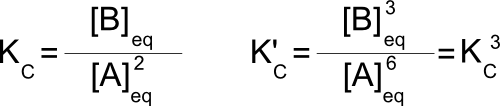
Consider the reaction 2A↔B with K=4.  We can multiply that reaction by 3 to get the reaction 6A↔3B.  Fundamentally, this is the same reaction and the same process, but what about the equilibrium constant?  Writing out the equilibrium constants for both reactions:
So if K = 4, K' = 43 = 64

Changing direction:
If we reverse a chemical reaction, we once again have to adjust the equilibrium constant.  Changing 2A↔B to B↔2A means that we are changing the identity of reactants and product.  This means that the concentrations that used to be in the numerator of the equilibrium constant are now in the denominator and vice versa.  Mathematically, this has the effect of inverting the value of the equilibrium constant.  If K = 4 for 2A↔B, then K"=1/4 for B↔2A.

Multipart/Multistep:
For a multistep process, the equilibrium position of each step will affect the overall equilibrium of the system.  This is in contrast to kinetics where the rate law of the overall process relies only upon the rate law of the slowest step.  For a stepwise process, the equilibrium constant for the overall process is equal to the product of the individual steps.


Manipulating Equilibrium

Because equilibrium is a dynamic, thermodynamic process, there are a number of things we can do to "fiddle with" equilibrium systems.  Perhaps the most significant conceptual tool we have at our disposal is LeChatelier's Principle.  {Side note: To the francophones in the audience, I believe the "a" in "LeChatelier" is supposed to have a little hat on it...}
When a system at equilibrium experiences a stress, the position of that equilibrium will shift to relieve the stress (as much as is possible).
What's stress?  The most common type of stress we're likely to see in chemical reactions is adding or removing a reactant or product.  Let's think about the simple equilibrium reaction 2A↔B.  The equilibrium constant is:
If we add a little extra "A" to the reaction after equilibrium has been established (a stress), the reaction will have to shift toward the products to re-establish equilibrium.  If we look at the reaction quotient, Q, for a reaction, we can evaluate whether a system is at equilibrium, and if it is not, what direction the system has to shift to reach equilibrium.  The reaction quotient has the same mathematical form as the equilibrium constant; if Q if less than K, then there are too many reactants in the system and it must shift toward products.  If Q is greater than K, then there are too many products and the system must shift toward reactants.


2012-02-16

Kinetics Experiments - The Nuts and Bolts


Last week in lab we performed a kinetics experiment in which we observed the iodination of acetone. For those of you who may be curious, there were a number of things that went into the planning of that experiment that are required to make it work as smoothly as it did. There is a certain art to experimental design, but it is all firmly rooted in the science that is being observed. For the kinetics of the iodination of acetone, the experimental design considerations are (in my opinion) fascinating, largely because they all make very good sense and can be understood with a Gen-Chem-level of knowledge.
  1. Relative concentrations of the reactants. Some of you may have noticed that the concentration of the iodine was very much less than the concentration of the other reagents. This was not an accident. First, since we were observing the color of the solution and that color was due to the iodine, the concentration of iodine had to be high enough to be easily observable but low enough to react in a reasonable amount of time. In addition to this very practical consideration, there is a chemical reason for the concentrations used. The rate of a chemical reaction is dependent upon the concentration of the reactants. As “good” scientists, we always want to design our experiments in such a way that only one variable is changing. If, for example, the concentration of iodine was 1M and the concentration of acetone was also 1M, then as the iodine concentration changed (and affected the rate of the reaction), the acetone concentration would also change and would also affect the rate of the reaction. Although this data could be mathematically interpreted, it would be much more convenient if only one of the concentrations was changing during the reaction. Is this possible? Of course not. Iodine cannot disappear unless it reacts with acetone (in this reaction). BUT, we can make it seemlike the acetone concentration is not changing by making the initial concentration of acetone SO high, that the change will be very small, indeed “negligible”, compared to the change in the iodine concentration. To put some numbers to it, if the initial concentration of iodine is 5mM and the initial concentration of acetone is 1.000M and the reaction is allowed to proceed, when all of the iodine has reacted, the final concentration of acetone would be 0.995M. Yes, the concentration has changed, but it has changed by only 0.5%. This means that the change in rate caused by the change in concentration of acetone can be ignored. The reaction (and reaction rate) will observe the rate law order with respect to iodine only.
  2. Limits of the Spec-20s. When we did the experiment, we said that the sample did not have to be put in the spectrometer until most of the color had faded. If anyone put their samples in the Spec-20 immediately, you might have noticed that the Spec-20 was unable to read the absorbance of the solution until most of the iodine color faded. This can be explained by thinking about the nature of “absorbance”. Absorbance is a logarithmic scale related to percent transmittance. An absorbance of “0” is equivalent to a percent transmittance of 100%. If the percent transmittance drops to 10%, the absorbance is “1”, which means 90% of the light that is shining on the sample is being absorbed. If the absorbance climbs to “2”, it means that only 1% of the incident light is getting through the sample (99% is absorbed). An absorbance of “3” means only 0.1% of the light is getting through. As we can see, increasing absorbance ver quickly decreases the amount of light getting through the sample. This brings us to the limits of the detector we are using. It can pretty easily discern the difference between 5% of the light being absorbed and 85% of the light being absorbed, but it's less reliable when trying to distinguish 97.8% absorbed and 98.5% absorbed. It is usually best practice to design experiments so the absorbances used are ~1.5 or less. If the absorbance is too high, the data will either get very “noisy”, or will just be abnormally low, making trends that should be linear appear curved.
  3. Aggregation of solutes. This probably wouldn't have been a big problem in our iodination of acetone experiment, but Beer's Law assumes that the solute particles are separate and independent in solution. If the concentration of colored solute is relatively high, it's possible that the colored solute particles will start to interact in a way that will make them absorb differently than if they were truly separate and independent in solution. This is often solved by addressing the instrument limits mentioned in #2; if the sample is diluted sufficiently bring to the absorbance down below ~1.5, it is usually dilute enough to avoid interactions between solute particles.

There are other considerations, but these are the big ones that often come up in experimental design for kinetics experiments and any experiment where we are observing color using a spectrometer. For most of our experiments, we set things up behind the scenes to minimize or eliminate these problems, but I hope that some of you were curious enough to wonder why the experiment was set up the way it was.

See you in the morning.

2012-02-15

Equilibrium is Organization!!

The key to equilibrium problems is almost always figuring out the best way to organize the data presented in the problem or experiment.  This is most often done by putting together a table.  Consider the following problem.

0.80mols NF3(g) and 0.60mols O2(g) are combined in a 1.00L vessel and allowed to reach equilibrium. At equilibrium, the concentration of NF3(g) is found to be 0.30M. What is the value of the equilibrium constant for this reaction?
Write a balanced chemical equation:
2 NF3(g) + O2(g) 2 NO(g) + 3 F2(g)

Set up a table to organize the data from the problem:

2 NF3(g) +
O2(g)
2 NO(g) +
3 F2(g)
[ ]initial
0.80 M
0.60 M
0 M
0 M
Δ[ ]
- 2x
- x
+ 2x M
+ 3x M
[ ]equil     
(0.80-2x) M
(0.60-x) M
2x M
3x M

Write an expression for the equilibrium constant:
Plug in values from the table:
Determine "x" from the problem.  We are told that [NF3]eq=0.30M, and we see in the table that [NF3]eq=(0.80-2x), so:
0.30 = 0.80-2x
x = 0.25
Plugging in:
K = 3.4
This equilibrium is (very slightly) product-favored.

Practice, practice, practice...

2012-02-13

Enter equilibrium

The steady state approximation applies to kinetic systems, but if we think about the nature of chemical reactions, we can say that all chemical reactions are microscopically reversible.  For the simple reaction A↔B
If we assume that the forward and reverse reaction both represent elementary steps, we can write rate law expressions for each direction:
Rateforward = kforward[A]0
Ratereverse = kreverse[B]0
After some time has passed, the rate of the forward reaction will be equal to the rate of the reverse reaction.
Rateforward = Ratereverse
kforward[A]0 = kreverse[B]0     
Rearranging to group constants and concentrations, we get the expression for the equilibrium constant.
Keq = [products]eq / [reactants]eq  
If [products]eq = [reactants]eq, then Keq = 1 and the reaction does not favor products or reactants.  If the equilibrium is product-favored, the the value of Keq will be larger than 1; if the equilibrium is reactant-favored, the the value of Keq will be less than 1 but still positive.

2012-02-10

Mechanisms

The mechanism for a chemical reaction is described by the rate law.  Mechanisms describe the collisional events that allow a reaction to occur and must obey 3 rules.
1. A mechanism must be composed of elementary steps/reactions.
2. The elementary steps of a mechanism, when added together, must yield the overall reaction
3. The observed rate law for the overall reaction must be consistent with the rate law for the slowest step
Elementary steps are the collisions that occur in a reaction.  Thinking about the probability of a collision, we can simplify the picture a little bit because it is extremely unlikely that more than 2 particles will collide with the proper orientation and energy to react.  This means that all elementary steps are either unimolecular or bimolecular.  {Yes, termolecular elementary steps are possible, but they're rarely significant contributors so we will ignore them for now.}
Once we have this series of elementary steps, what do we do with them?  Because elementary steps describe collisions at the molecular level, we can write rate laws for each of the elementary steps based only upon the balanced reaction of the elementary step.  Since doubling the number of any molecule will double the probability of a collision (the rate), the elementary steps are first order with respect to each reacting molecule.
Rates are determined by the activation energy of a step or an overall process; the higher the activation energy, the slower the rate.  For a series of steps, whichever step has the highest activation energy will determine (or limit) the rate for the entire process, so it is known as the Rate Determining (or Limiting) Step, the RDS (or RLS).  With a little algebra, we can wrassle the rate law of the RDS into a form that looks like the observed rate law.  The rate law expression for the overall process shown below, A + B + D→E, is
Rateobs = kobs[A]0x[B]0y[D]0z
If the first step is RDS, we can write the rate law expression for the first step:
Rate1=k1[A]01[B]0y
This rate law, looks just like the observed rate law if the reaction is first order with respect to [A] and [B], so if the first step is RDS, this is a pretty straight-forward problem with minimal algebraic wrasslin'.

For the second step RDS, we have to use a steady state approximation to make the rate law "consistent with" the observed rate law.  The rate law for the second step is:
Rate2=k2[C]01[D]01
But [C] does not appear in the overall observed rate law expression, so we have to figure out a way to make this expression "consistent with" the observed rate law for the overall process.  If most of "C+D" has quite a bit of energy, but not quite enough to get over the C+D→E hump, it probably has enough energy to go backwards and return to "A+B".  This means we can define another rate law, this time for the reverse of step 1, C+D→A+B:
Rate-1=k-1[C]01[D]01
As the rxn A+B→C+D proceeds, eventually we will build up a concentration of "C+D" that will remain essentially constant throughout the reaction.  This is the "steady state".  When we reach this steady state, the rate of step 1 going forward (Rate1) will be equal to the rate of step 1 in reverse (Rate-1):
Rate1 = Rate-1
Which means that:
k1[A]01[B]01 = k-1[C]01[D]01
Now we can solve for  [C]01 :
[C]01 = {k1/k-1}[A]01[B]01/[D]01
Now, we can plug the expression for  [C]01 into the rate law expression for step 2:
Rate2 =  k2({k1/k-1}[A]01[B]01/[D]01)[D]01 = kcombined[A]01[B]01  
Note: Since "k1", "k-1", and "k2" are constants, we can just lump them together into a single constant, in this case labelled "kcombined".
So if the second step is slow, the observed rate law should be first order w.r.t. [A] and [B], zero order w.r.t. [D].  Note that this is the same as the observed rate law expression if the first step is slow, so how can we distinguish between these two mechanisms?  Typically there would have to be something else observable in the reaction.  If step 2 is slow, then during the course of the reaction, we might expect to see a measurable concentration of "C" appear when the steady state is established and then disappear when the reaction is complete.  We might also be able to analyse the value of "kobserved" to see a difference, but that's often a bit more challenging than detecting an intermediate in the reactions.

Yikes, that one got a little long.  Have a good weekend.

2012-02-08

Logarithms

Logarithms used to be extremely important.  With modern calculators, logarithms aren't quite as critical as they used to be, but they're still very useful in some cases.  There are a few definitions and identities that will help us out a bit, the most basic ones are:
log (10x) = 10log x = x
ln (ex) = eln x = x
The following work for either common logs (log, base 10) or natural logs (ln, base "e"):
log (AB) = log A + log B
log (A/B) = log A - log B
log (AB) = B log A
A little practice will help lock these in.  Good luck.


Integrated Rate Laws and Activation Energy

There's a new bit of OWL assignment posted, make sure you take a look.

Rate laws can tell us a lot about a reaction, but a simple rate law doesn't do a great job of telling us how fast or slow a reaction really is.  In order to incorporate a time component, we can integrate the rate law expressions.  The integrated rate laws (IRLs) give us a way to monitor the way concentrations change over time.
0th Order IRL → [A]t = -kt + [A]0
1st Order IRL → ln[A]t = -kt + ln[A]0
2nd Order IRL → {1/[A]t} = kt + {1/[A]0}
IRLs can also be used to determine the order of a reaction with respect to a given reactant.  All of the IRLs listed above are equations of lines.  If we plot [A]t vs. t and the result is a straight line, then the process must be 0th order w.r.t. [A].  Likewise, a linear plot of ln[A]t vs. t implies a 1st order process, and a linear plot of {1/[A]t} vs. t implies a 2nd order process.

Why do reactions have the rates they do?  This is a function of the amount of energy required to make a reaction occur.  Recall from Collision Theory that collisions must occur and those collisions must be oriented and energetic.  The energy required to get a reaction started is the activation energy, Ea.  Activation energy is described by the Arrhenius equation:
k = A exp(-Ea/RT)
where:
k = rate law constant
A = frequency factor
Ea = activation energy
R = universal gas constant, 8.314 J/mol.K
T = temperature in units of Kelvin
Although this is an elegant little bit of mathematics, it's not the most useful form of the Arrhenius equation.  If 2 sets of conditions are known, we can set up a ratio of the Arrhenius equation for each run and ultimately find that:
ln(k1/k2) = (Ea/R)({1/T2} - {1/T1})
The comparative form works well, but it has a notable flaw.  We have to assume that both of the points of data that we have a quite good and accurate.  Hopefully this is the case, but it might not be, leading to error.  If we want to average out some of that error, we can do another transformation of the Arrhenius equation to form a line:
ln(k) = (-Ea/R)(1/T) + ln(A)
Friday we'll look more closely at activation energy and what it means in terms of reaction mechanisms.

2012-02-06

Rate Laws

We can calculate the instantaneous rate for any point in a concentrations vs. time experiment, but the only really unique and important one is the initial instantaneous rate.  The initial rate of a reaction is described by a rate law.  The initial rate of a chemical reaction is proportional to the initial concentration of all the reactants raised to some power.  To remove the proportionality, we can add a constant, the rate law constant.
Rate0 = k [reactant]0x
We can write a rate law expression for any chemical reaction as long as we know the reactants.  For example, for the generic reaction:
aA + bB → cC + dD
The rate law expression is
Rate0 = k[A]0x[B]0y
If we think about this rate law expression, there seem to be a LOT of variables present.  We can determine the value of a number of those variables if we design our experiments thoughtfully.  Let's look at a specific example.
For the reaction of NO2(g) with Cl2(g), we have performed the following experiment: [NO2]0 = 1.228M, [Cl2]0 = 1.316M, Rate0 = 2.881x10⁻³ M/min.  The rate law expression for this reaction is:
Rate0 = k [NO2]0x[Cl2]0y
Notice that we don't really need to know the products or the balanced chemical equation to write out the rate law expression.  That doesn't mean we don't have to practice balancing chemical equation, keep on practicing!!  Plugging the numbers in to the rate law expression:
(2.881x10⁻³ M/min) = k (1.228M)x(1.316M)y
That's still 3 variables, so we need (mathematically) more equations to help us solve them.  We could just randomly start mixing reactants together, but if we're deliberate in our planning, we can make our jobs a little easier.  As good scientists, we try to change one 1 variable at a time whenever we're doing an experiment.  Why?  Because then if the result changes, we know it has to be caused by the variable we changed.  In this case, we can set up another experiment, and let's change the initial concentration of NO2 but hold the initial concentration of Cl2 constant.  For our second run: [NO2]0 = 2.456M, [Cl2]0 = 1.316M, Rate0 = 1.152x10⁻² M/min.  Plugging in to the rate law expression again, we get:
(1.152x10⁻² M/min) = k (2.456M)x(1.316M)y
Let's get a little mathematical here... if these two equalities are valid (which they are), then their ratio is also a valid equality.  Bam.  Cancelling out everything that can cancel, we're left with the simplified expression:
(1/4) = (1/2)x
x = 2
Therefore, the reaction is second order with respect to [NO2]0.

2012-02-01

Kinetics, at an average rate...

Kinetics is the study of the rates and mechanisms/pathways of chemical reactions.  Most of kinetics can be understood by probability and the 3 points of Collision Theory: For a chemical reaction to occur: 1) Collisions between reactant particles must occur; 2) The collisions must be energetic enough to allow reaction; 3) The colliding particles must be oriented in a way that gives the desired reaction.  The probabilities is Collision Theory are affected by changes in temperature and concentration/pressure.

Rates can be expressed in a number of ways, but for most chemical systems, the rate is equal to the change in concentration over the change in time.  When that change in time is (relatively) long, we have an average rate.  Average rates can be either in terms of consumption of a reactant or production of a product.  The mathematical formality of "change in concentration" requires a negative sign on rates of consumption.  Rates of consumption or production are related to the stoichiometric coefficients in the balances chemical equation that is being observed and can be unified as a rate of reaction.

A significant disadvantage of average rates is that they change depending upon the time period being measured.  To more accurately estimate the rate of a reaction, we should use smaller time periods.  Taken to the extreme, we can calculate an instantaneous rate at any point during a reaction.  Of all the instantaneous rates for a given reaction, the only important or unique instantaneous rate is the very first one, the initial instantanous rate of the reaction.

On Friday, we'll continue with kinetics.  You will very likely NOT get your exams back on Friday.  A number of things came up today (and continue tomorrow) that will make it difficult to get exams back on Friday.  I will have them done over the weekend and will return them first thing Monday morning.  Sorry for the delay.

2012-01-25

Nature of solutions

We took a little step away from colligative properties today to make sure we're all familiar with some of the terminology of solutions.  Solubility is not a "yes/no" question.  Is potassium nitrate soluble?  Yes, all potassium salts are soluble and all nitrate salts are soluble, so potassium nitrate must be soluble.  If we take 1 gram of KNO3(s) and add it to 1L of water, it will dissolve.  What if we take 1 kilogram of KNO3(s) and add it to 1mL of water?  Will it dissolve?  Yes, but will ALL of it dissolve?  I think not.  If we start with 1L of water and slowly add KNO3(s), at some point the excess KNO3(s) will no longer dissolve because the solution has become saturated.  A saturated solution represents the maximum amount of a solute that can dissolve in a given amount of solvent.  Sometimes, a solution can become supersaturated when "extra" solute is dissolved; supersaturated solutions are unstable and will form precipitate if a nucleation site is present.  This can be a speck of dust, or a scratch in the glass of the container, or a seed crystal of the substance.

We also looked at the temperature dependence of solubility.  For solids dissolving in liquids, heating the solution will usually allow more solute to dissolve.  This is one way to make supersaturated solutions; a hot saturated solution is allowed to cool in the absence of nucleation sites.  For gases dissolved in liquids, the situation is reversed; cold solvent is usually able to hold more dissolved gas than hot solvent because the gas solute particles in the hot solution have more kinetic energy and are more likely to escape from the solution.

Returning to colligative properties, we began to discuss the most important colligative property in biological systems, osmosis.  When two solutions of differ in concentration are separated by a semipermeable membrane, solvent tends to flow from the less concentrated side to the more concentrated side.  What's a semipermeable membrane?  Cell walls.  Skin.  LOTS of biological things are semipermeable membranes and control function by regulating osmosis.  Awesome.

There's new OWL posted, and don't forget to take the pre-lab quiz before 8:00am tomorrow.