A couple more email questions:
-----Question-----
On exam b spring 2011 #5 why should this be changed to Ka instead of Kb? Also on exam b spring 2010 #2 the 3rd line its says that HCl works as an effective buffer. I thought an effective buffer had to be a weak conjugate acid/base?
-----Answer-----
Here's question #5
This is Ka because ammonium ion is a conjugate acid. You could also do this as a Kb equilibrium, but you'd be starting with products and shifting to the left to form reactants. Either way should give the same answer.
Here's #2:
Correct, an effective buffer is an approximately equimolar combination of a weak conjugate acid and its weak conjugate base. In the 3rd line here, HCl(aq) is protonating the carbonate in solution 1.5 times so the resulting mixture is 0.64mols HCO3-1(aq) and 0.64mols H2CO3(aq). This is an equimolar mixture of a weak acid and its conjugate base, so it should be a good buffer. {NOTE: because carbonic acid decomposes and the resulting CO2 can escape from solution, this might not be the best buffer in the real world, but it works fine as a sample problem.} This is similar to how you are making the carbonate buffer that you will measure in lab this week.
Info and advice to help General Chemistry students (and anyone interested in chemistry)
Showing posts with label acid. Show all posts
2014-04-01
2014-03-30
Pre-Exam 3 email questions...
A few questions have come in by email, here they are:
----Question-----
----Answer-----
----Question-----
I was going through some of the old exams and the problems that use the Henderson - Hasselbalch. In those examples when it asked for the concentration of the conjugate base over the concentration of conjugate acid, but in the key only the moles of both are put in those places. Why?
----Answer-----
Keep an eye on the weather... Unless MSUM officially closes campus tomorrow, we will have class and the exam as planned. I'll be there at 7:30.
----Question-----
I have a question regarding problem 9 on exam 3a from spring 2013. I understand that the calculated x value doesn't fit under the assumptions. I see where the first two values come from. I was wondering where the -1.238 x 10^-3 came from?
{(x)(x)} / (0.516 – x) = 2.40 x 10^-3
0.516 is the initial concentration and 2.40 x 10^-3 is Ka.
x^2 + (2.40 x 10^-3)x + (-1.238 x 10^-3 ) = 0
In order to use the quadratic formula, we have to solve the equation to the form:
ax2 + bx + c = 0
The (-1.238x10⁻³) term comes from (2.40x10⁻³)(0.516).
----Question-----
I was going through some of the old exams and the problems that use the Henderson - Hasselbalch. In those examples when it asked for the concentration of the conjugate base over the concentration of conjugate acid, but in the key only the moles of both are put in those places. Why?
----Answer-----
This is a little mathematical shortcut. Since both the conjugate acid and conjugate base are in the same total volume of solution, the volumes mathematically cancel so I left them out. For example, if we had a buffer made from 0.65mols of HA and 0.55mols of A-1 in 800.0mL of buffer solution, that last part of the Henderson-Hasselbalch would look like:
You can always keep the volume in there and calculate the actual concentrations of each component, you should get exactly the same answer either way.
----Question-----
I dont understand how you can derive pH values from pka's given in the question. I also dont understand how pH can be calculated at each eq point in the titration curve as in number 11 on spring 2013 where it asks what indicator to use.. it says use the 2 pkas...how does this help?
----Answer-----
I dont understand how you can derive pH values from pka's given in the question. I also dont understand how pH can be calculated at each eq point in the titration curve as in number 11 on spring 2013 where it asks what indicator to use.. it says use the 2 pkas...how does this help?
----Answer-----
There are a couple ways that pKa (or pKb) can lead to a pH. One possibility is in a question like "What is the expected pH of a 0.618M solution of ammonium nitrate solution?" In this question, you can set up a Ka-type equilibrium for ammonium ions and use the Ka of ammonium to calculate [H3O+] and pH. This is similar to the problem I posted yesterday (http://chemistryingeneral.blogspot.com/2014/03/neutral-salts.html). This method can be used to calculate the initial pH for a titration. It would also work to approximate the pH of an equivalence point. Let's think about that...
For the titration of phosphite ions with hydrochloric acid, we can calculate the initial pH by setting up a Kb-type equililbrium and using the Kb of phosphite ion to calculate [OH-1] and pOH and pH. At the first equivalence point in this titration, we have a solution that we can think of as HPO3-2(aq) because we have added just enough acid to complete the following equation exactly once:
PO3-3(aq) + H+(aq) <=> HPO3-2(aq)
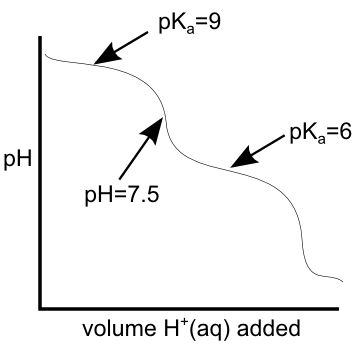
Between equivalence points, we have buffering regions of the titration curve... at the mid-point of this buffering region, the pH is equal to the pKa of the weak acid of the mixture. If we know the pKa (and therefore the pH) on either side of the equivalence point we're interested in, we can get a pretty reliable estimate of the pH of that equivalence point. On the titration curve below, if the pKas that bound the equivalence point are 6 and 9, the pH of the equivalence point should be right between them at pH = 7.5.Keep an eye on the weather... Unless MSUM officially closes campus tomorrow, we will have class and the exam as planned. I'll be there at 7:30.
2014-03-29
Neutral salts
The conjugate of a strong acid or strong base is neutral. That's just something we tend to accept, memorize, and move on. But why? Those two words are a big part of the reason I'm a chemist.
Let's take a look at a strong acid and see if we can make sense of this. Of the typical strong acids, nitric is usually the weakest, and nitric is also the only one that might have a Ka listed in standard tables. The stronger strong acids have really useful Ka values listed in the tables like "large" or "strong"... I don't have a "large" button on my calculator, so let's just use nitric acid and we'll hopefully see why the other strong acids would follow the same trend if we had a value for their Ka.
The Ka for nitric acid is usually listed at around 25. That means the Kb for nitrate ions is:
That's a REALLY weak Kb, but we can go ahead and calculate the pH of a solution just like in any other situation. How about the problem: What is the expected pH of a 0.500M solution of sodium nitrate? {By the way, we could make similar arguments to show that the sodium ions don't affect the pH, but we'll save those for another day...} As with all good equilibrium problems, it's probably not a bad idea to start with a table:
Now we can set up the Kb expression and plug in the numbers we have:
We should be able to simplify that with some assumptions... Let's assume that "x" is much smaller than 0.500 and much larger than 10-7. That gets us the simplified expression:
Solving this expression, we get x = 1.41x10⁻⁸, which gives us a pOH = -log(1.41x10⁻⁸) = 7.85, and pH = 6.15. Hmm, that's not neutral, that's acidic. The whole point of this was to prove that nitrate was a neutral ion. This is a disaster.
BUT WAIT!
We made some assumptions. We didn't check our assumption after we solved for "x". This is why I always tell you to check assumptions... We assumed that "x" would be much smaller than 0.500, which it is, but we also assumed that "x" was much larger than 10-7, which it absolutely is not! So the assumptions we made were an oversimplification of the problem and that's where we entered the danger zone. Looking back at our Kb expression, we can only simplify it to:
That's still going to require the quadratic formula to solve. I'll let you work out the details, but the result should be that x = 7.96x10⁻⁹. That means:
Let's take a look at a strong acid and see if we can make sense of this. Of the typical strong acids, nitric is usually the weakest, and nitric is also the only one that might have a Ka listed in standard tables. The stronger strong acids have really useful Ka values listed in the tables like "large" or "strong"... I don't have a "large" button on my calculator, so let's just use nitric acid and we'll hopefully see why the other strong acids would follow the same trend if we had a value for their Ka.
The Ka for nitric acid is usually listed at around 25. That means the Kb for nitrate ions is:
That's a REALLY weak Kb, but we can go ahead and calculate the pH of a solution just like in any other situation. How about the problem: What is the expected pH of a 0.500M solution of sodium nitrate? {By the way, we could make similar arguments to show that the sodium ions don't affect the pH, but we'll save those for another day...} As with all good equilibrium problems, it's probably not a bad idea to start with a table:
Now we can set up the Kb expression and plug in the numbers we have:
We should be able to simplify that with some assumptions... Let's assume that "x" is much smaller than 0.500 and much larger than 10-7. That gets us the simplified expression:
Solving this expression, we get x = 1.41x10⁻⁸, which gives us a pOH = -log(1.41x10⁻⁸) = 7.85, and pH = 6.15. Hmm, that's not neutral, that's acidic. The whole point of this was to prove that nitrate was a neutral ion. This is a disaster.
BUT WAIT!
We made some assumptions. We didn't check our assumption after we solved for "x". This is why I always tell you to check assumptions... We assumed that "x" would be much smaller than 0.500, which it is, but we also assumed that "x" was much larger than 10-7, which it absolutely is not! So the assumptions we made were an oversimplification of the problem and that's where we entered the danger zone. Looking back at our Kb expression, we can only simplify it to:
That's still going to require the quadratic formula to solve. I'll let you work out the details, but the result should be that x = 7.96x10⁻⁹. That means:
[OH-1]eq = 10-7 + (7.96x10⁻⁹) = 1.08x10⁻⁷ M
pOH = -log(1.08x10⁻⁷) = 6.9667
pH = 14 - 6.9667 = 7.0333
That's not exactly 7.0000000000 neutral, but it's pretty darn close, especially if we're thinking about this in terms of selecting a visual acid-base indicator for a titration.
2013-07-18
In-Class problems 2013-07-18
Today was buffers day in class so we looked at 294 different ways to use the Henderson-Hasselbalch equation. Remember, the Henderson-Hasselbalch equation is just a rearrangement of the Ka expression we use for understanding any acid... You can always plug directly into the Ka expression and get the same result you will get using Henderson-Hasselbalch. So the problems...
1. Combine 12.642g of chlorous acid
with 15.372g of lithium chlorite, dilute to 500.0mL. What is the
expected pH of this buffer? (Chlorous acid Ka = 1.12x10⁻²)
Plug into the Henderson-Hasselbalch
equation...
And solve...
2. Prepare 500.0mL of a 0.650M HN3/N3-1
buffer at pH = 5.10 from HN3(s) and NaN3(s).
(Hydrazoic acid Ka = 1.93x10⁻⁵)
Start off by solving for the ratio of
conjugate acid to conjugate base using either the
Henderson-Hasselbalch equation or just an unmodified Ka
expression. I'll use H-H...
[N3-1]
/ [HN3] = 2.4297
[N3-1]
= 2.4297[HN3]
Now that we know the ratio
of these concentrations, we can solve for the actual concentrations
by using the relationship...
0.650M = [HN3]
+ [N3-1]
0.650M = [HN3]
+ 2.4297[HN3] = 3.4297[HN3]
[HN3] = 0.1895M
[N3-1]
= 0.650 – [HN3] = 0.650 – 0.1895 = 0.4605M
To make a solution that's 0.1895M HN3
at 500.0mL, we need...
(0.5000L)(0.1895M) =
0.09475mols HN3
(0.09475mols
HN3)(43.029g/mol) = 4.077g HN3(s)
To make a solution that's 0.4605M N3-1
at 500.0mL, we need...
(0.5000L)(0.4605M) =
0.23025mols N3-1
(0.23025mols
N3-1)(65.011g/mol) = 14.969g NaN3(s)
So we should be able to make the target
buffer by combining 4.077grams of HN3 and 14.969g of NaN3
in enough water to make 500.0mL of solution.
NOTE: If you're actually making a
buffer, be very careful about the order of addition of the
components. Whenever you're combining a solid or concentrated
solution with a solvent, it's usually a good practice to add the
solid or concentrated stock to the larger volume of solvent slowly
with very good mixing. Dissolving and/or mixing can liberate a LOT of
heat in some cases that could be dangerous if the order of addition
is reversed.
NOTE2: Hydrazoic acid is not a solid at
room temperature, and the pure liquid is a non-trivial safety risk...
We can talk about this type of a buffer on paper, but there's very
little chance you (or I) will ever prepare or use a hydrazoic
acid-based buffer.
3. What is Ka of a weak
acid, “HA”, if a solution made by dissolving 0.316mol HA and
0.327mol A-1 in water and diluting to 750.0mL has a pH of
9.374?
Plug in to Henderson-Hasselbalch or the
generic Ka expression...
9.374 = pKa +
log (0.327 / 0.316)
pKa = 9.359
Ka =
4.374x10⁻¹⁰
4. What is Kb of a weak
base, “B”, if a solution made by dissolving 0.143mol B and
0.158mol HB+1 in water and diluting to 400.0mL has a pH of
5.975?
Similar to the previous problem, plug
in to Henderson-Hasselbalch or the generic Ka expression...
5.975 = pKa +
log (0.143 / 0.158)
pKa = 6.018
pKb = 14 –
6.018 = 7.892
Ka = 1.043x10⁻⁸
2013-04-28
Working with ammonia
From my perspective, aqueous ammonia is a fascinating reagent to use in the lab. As a type of matter, it is a gas dissolved in a liquid, which seems pretty wild. In many cases, aqueous ammonia is just a fairly typical weak base that's nothing all that special as long as you're using the Bronsted-Lowry definition of a base. Those are great features of aqueous ammonia, but they really pale in comparison to what we see when we start combining aqueous ammonia with metal ions, especially transition metal ions. The key to thinking about aqueous ammonia in these situations is to remember that aqueous ammonia is always involved in a Kb-type equilibrium:
How do we tell which is which? Whenever possible, by comparison with know reactions. If the observed reaction between a metal ion and aqueous ammonia looks identical to the reaction of that same metal ion with a known hydroxide source {like NaOH(aq)}, then the metal ion is probably more attracted to oxygen lone pairs and is reacting with the hydroxide ions in the aqueous ammonia. If, however, the observed reaction between a metal ion and aqueous ammonia is different from the reaction of that same metal ion with NaOH(aq), then the metal ion is probably reacting with the ammonia molecules in the aqueous ammonia solution.
Differential affinities between metal ions (Lewis acids) and different Lewis base donors is a very diverse field and was a driving force in chemistry before newer instrumental methods were developed. It's still an important consideration in chemistry and physics and biology... Biology? That's right! Every biological system that contains metal ions (especially transition metal ions) relies heavily upon differential binding affinities to function correctly. And that's just one of the many reasons why biologist need to understand chemistry...
NH3(aq) + H2O(l) <=> NH4+1(aq) + OH-1(aq)
This means that in any solution of aqueous ammonia, there are both ammonia molecules and hydroxide ions. If we think about the Lewis definitions of acids and bases, this means that floating around in every solution of aqueous ammonia, there are nitrogen-based lone pairs of electrons on ammonia molecules and oxygen-based lone pairs of electrons on hydroxide ions. Different metal ions have different affinities for different types of lone pairs, so sometimes when a metal ion is added to aqueous ammonia it forms complexes with ammonia while other times it forms complexes with hydroxide.How do we tell which is which? Whenever possible, by comparison with know reactions. If the observed reaction between a metal ion and aqueous ammonia looks identical to the reaction of that same metal ion with a known hydroxide source {like NaOH(aq)}, then the metal ion is probably more attracted to oxygen lone pairs and is reacting with the hydroxide ions in the aqueous ammonia. If, however, the observed reaction between a metal ion and aqueous ammonia is different from the reaction of that same metal ion with NaOH(aq), then the metal ion is probably reacting with the ammonia molecules in the aqueous ammonia solution.
Differential affinities between metal ions (Lewis acids) and different Lewis base donors is a very diverse field and was a driving force in chemistry before newer instrumental methods were developed. It's still an important consideration in chemistry and physics and biology... Biology? That's right! Every biological system that contains metal ions (especially transition metal ions) relies heavily upon differential binding affinities to function correctly. And that's just one of the many reasons why biologist need to understand chemistry...
2013-04-04
Exam questions in my email...
A couple questions have trickled in to my email box...
--Question 1------------
Quick question, what does it mean to be diprotic or monoprotic? And how do you know if something is diprotic monoprotic?
-------------------------
This refers to how many acidic protons (H+) there are on an acid, how many protons can be donated. Something like HCl(aq) only has 1 H+ to donate so it's monoprotic. Phosphoric acid has 3 acidic H+ so it's triprotic. Usually it's just a matter of "count the H's" in the formula, but for organic acids (and some others...) there are H's that are not acidic. Think of the acetic acid you used in lab... CH3COOH(aq)... the 3 H's that are connected to carbon are not acidic, only the H attached to oxygen is acidic, so this is a monoprotic acid.
I will often use shorthand terminology and refer to bases as being "monoprotic" to mean that the base can accept only 1 proton or "diprotic" if the base can accept 2 protons.
--Question 2------------
On one of the practice exams there is a question that asks for a detailed titration curve. What exactly would you be looking for in something like that as far as details to include?
-------------------------
--Question 1------------
Quick question, what does it mean to be diprotic or monoprotic? And how do you know if something is diprotic monoprotic?
-------------------------
This refers to how many acidic protons (H+) there are on an acid, how many protons can be donated. Something like HCl(aq) only has 1 H+ to donate so it's monoprotic. Phosphoric acid has 3 acidic H+ so it's triprotic. Usually it's just a matter of "count the H's" in the formula, but for organic acids (and some others...) there are H's that are not acidic. Think of the acetic acid you used in lab... CH3COOH(aq)... the 3 H's that are connected to carbon are not acidic, only the H attached to oxygen is acidic, so this is a monoprotic acid.
I will often use shorthand terminology and refer to bases as being "monoprotic" to mean that the base can accept only 1 proton or "diprotic" if the base can accept 2 protons.
--Question 2------------
On one of the practice exams there is a question that asks for a detailed titration curve. What exactly would you be looking for in something like that as far as details to include?
-------------------------
You caught me... I usually don't include those drawings in the keys because I type the keys and those titration curves are a little hard to draw electronically... I've drawn a couple and they look horrible. When drawing a titration curve like this, you should label any equivalence points, indicate the species present in solution, label any pH's you can reasonably estimate (or might know...), maybe something like this:
You don't have to label all of those pH values, but again, if you know the pH values for some of those points, you might as well use them to draw a titration curve that's a little more quantitatively accurate.
Other questions, let me know.
2013-04-03
Titration question...
Email question:
------------
I am having trouble with this question from a previous exam: You find that 25.00mL of phosphorous acid requires 41.39 mL of Sodium hydroxide to reach the second equivalence point. What is the concentration of the phosphorous acid solution?
I understand the process of what to do in this question, but am really struggling understanding why we are supposed to use the equation that you used in the explanation: H3PO3(aq) +2 OH-1(aq)†(一)2O(l) +HPO3-2(aq)
Earlier in this problem, we broke down this into three different equations, and I don't understand why we don't use
H2PO3-1 + OH-1 --> H2O + HPO3-2?
------------
The equation you list gets us from the first equivalence point to the second equivalence point. In the titration described in the equation, we're going from phosphoric acid all the way to the second equivalence point, so we're doing 2 steps of the potential 3 step process. To get to the second equivalence point, have to go through the following steps:
H3PO3(aq) + OH-1(aq)(aq) <=> H2O(l) + H2PO3-1(aq)
H2PO3-1(aq) + OH-1(aq) <=> H2O(l) + HPO3-2(aq)
------------
I am having trouble with this question from a previous exam: You find that 25.00mL of phosphorous acid requires 41.39 mL of Sodium hydroxide to reach the second equivalence point. What is the concentration of the phosphorous acid solution?
I understand the process of what to do in this question, but am really struggling understanding why we are supposed to use the equation that you used in the explanation: H3PO3(aq) +2 OH-1(aq)†(一)2O(l) +HPO3-2(aq)
Earlier in this problem, we broke down this into three different equations, and I don't understand why we don't use
H2PO3-1 + OH-1 --> H2O + HPO3-2?
------------
The equation you list gets us from the first equivalence point to the second equivalence point. In the titration described in the equation, we're going from phosphoric acid all the way to the second equivalence point, so we're doing 2 steps of the potential 3 step process. To get to the second equivalence point, have to go through the following steps:
H3PO3(aq) + OH-1(aq)(aq) <=> H2O(l) + H2PO3-1(aq)
H2PO3-1(aq) + OH-1(aq) <=> H2O(l) + HPO3-2(aq)
So the whole 2-step process to get from the beginning of the titration to the second equivalence point has the net equation:
H3PO3(aq) + 2 OH-1(aq) <=> 2 H2O(l) + HPO3-2(aq)
That's where the 2:1 stoichiometry comes from.
2012-03-20
Titrations I - Monoprotic/Monoprotic
When we're dealing with acid-base chemistry, we have to be able to determine the concentration of the acids and bases that we're using. This most often means performing a titration where one of the components is known. The absolutely 100% most important thing about titrations is to remember that titrations are stoichiometryproblems, and they should be treated as such. There's nothing new and magical about titrations, they're just stoichiometry problems applied to a specific situation. The 4 steps to solve every stoichiometry problem are:
1) Write a balanced chemical equation
2) Calculate moles of one component (“moles of known”)
3) Convert moles of known to moles of interest using the ratios in the balanced chemical equation
4) Convert moles of interest to whatever you want to find
With acid-base titrations, it is most often convenient to monitor pH of the solution. To explore the pH-dependence of a titration, we can look at a system where we know all the concentrations. Let's say we are titrating 25.00mL of 0.85M nitrous acid, HNO2(aq), with 0.85M KOH(aq). At the beginning, we have a solution of a weak acid, so we can calculate the initial pH using a Kaexpression. Looking up the Kaof nitrous acid online gives a couple different values, let's say that it's around 5x10⁻⁴ . Kais just like every other equilibrium, so let's set up a table...
- HNO2(aq) +H2O(l) ↔H3O+(aq) +NO2-1(aq)[ ]initial0.85MXXXX10-7 M0 MΔ [ ]- x MXXXX+ x M+ x M[ ]equilibrium(0.85 – x) MXXXX(10-7 + x) Mx M
Plugging in values:
That expression is solvable by the quadratic formula (and I encourage you to solve it for practice and to convince yourself that the things we're about to do are valid), but we might be able to simplify it if we make some assumptions about the size of “x”. Since this is a weak acid (Ka< 1), it's probably reasonable to assume that most of the HNO2molecules will still be intact when this system reaches equilibrium, so although we will lose some (Δ[ ] = -x), the value of “x” will probably be quite small compared to 0.85, so we can assume that (0.85 – x) ≈0.85. At the same time, although “x” is probably small, 10-7is really small, so there's a pretty good chance that (10-7+ x) ≈x. With these two assumptions (which we have to check later) in place, the Kaexpression simplifies to:
x = 0.0206
Before we do anything else, we need to pause to check that the assumptions we made are indeed reasonable. 0.0206 is truly massive compared to 10-7so the second assumption is great. For the first assumption, it's a little closer; 0.0206 is certainly smaller than 0.85, but is it smaller enough?
(0.0206 / 0.85 ) *100 = 2.4%
Usually, the limit is around 5%, so we should be OK here as well. The pH of this solution at the beginning of the experiment should be:
pH = -log[H3O+] = -log(0.0206) = 1.686
What happens to the pH when we start adding KOH(aq)? Well, KOH is a base, so the pH will go up, but howwill it go up? We can calculate that. Starting with 25.00mL of 0.85M nitrous acid, let's add 5.00mL of 0.85M KOH(aq). To make it easier to keep track of everything, let's start by writing out a chemical equation and converting to moles:
HNO2(aq) + KOH(aq) ↔ H2O(l) + KNO2(aq)
Mols HNO2: (0.02500L)(0.85M) = 0.02125mols HNO2
Mols KOH(aq): (0.00500L)(0.85M) = 0.00425mols KOH
We can assume that all of the OH-1(aq) that is added will react with the H+/HNO2 that is present in solution, so after this 5.00mL addition, we should have a solution that contains:
0.02125 – 0.00425 = 0.017mols HNO2(aq)
This nitrous acid is now in (25.00 + 5.00 = 30.00mL) of solution {if we assume that the volumes are additive}, so the concentration of nitrous acid is:
0.017mols / 0.03000L = 0.5667M
And the concentration of nitrite ions is:
0.00425mols / 0.03000L = 0.1417M
We can calculate the pH by treating this like an equilibrium problem, just like above, setting up a table. The pH of the solution should be the same as if we had made a new solution by adding 0.017mols of HNO2 and 0.00425mols of NO2-1 to enough water to make 30.00mL of solution:
- HNO2(aq) +H2O(l) ↔H3O+(aq) +NO2-1(aq)[ ]initial0.5667MXXXX10-7 M0.1417 MΔ [ ]- x MXXXX+ x M+ x M[ ]equilibrium(0.5667 – x) MXXXX(10-7 + x) M(0.1417 + x) M
Making similar assumptions, the expression simplifies to:
x = 0.002000
Checking assumptions again, they are all valid, so:
pH = -log[H3O+] = -log(0.002000) = 2.699
We can continue adding 5.00mL portions of the KOH(aq) and calculating to get the values shown in the table:
mL KOH(aq) added | pH |
0.00 | 1.686 |
5.00 | 2.699 |
10.00 | 3.125 |
15.00 | 3.477 |
20.00 | 3.903 |
But what happens when 25.00mL of the KOH(aq) solution is added? At that point, the mols of OH-1 that have been added is exactly equal to the mols of acid that were present in the original solution. This is an equivalence pointin the titration. If we look at the balanced chemical equation for the process,
HNO2(aq) + KOH(aq) ↔ H2O(l) + KNO2(aq)
The solution we have produced by titrationis the exact same solution that we would have produced if we had simply dissolved 0.02125mols of KNO2in enough water to make 50.00mL of solution. Since NO2-1(aq) is the conjugate base of nitrous acid, we can think about it being involved in a Kbequilibrium with water, Kb(NO2-1) = 2x10-11. Set up a table...
- NO2-1(aq) +H2O(l) ↔OH-1(aq) +HNO2(aq)[ ]initial0.425MXXXX10-7 M0 MΔ [ ]- x MXXXX+ x M+ x M[ ]equilibrium(0.425 – x) MXXXX(10-7 + x) Mx M
Again, we can make assumptions similar to the above examples to get x = 2.92x10-6 = [OH-1].
pOH = -log[OH-1] = -log(2.92x10⁻⁶) = 5.535
pH = 14 - pOH = 8.465
If we keep adding KOH(aq), the mixture will continue to get more basic, eventually leveling off as the concentration of excess hydroxide reaches a limit. {Sounds like a fascinating calculus problem, the concentration should asymptotically approach 0.85...} If we plot this pH data, we get a titration curvelike the one shown below.
Labels:
acid,
base,
chemistry,
equilibrium,
Ka,
nitrous,
stoichiometry,
titration
Subscribe to:
Posts (Atom)