Showing posts with label chemistry. Show all posts

2023-08-28

C150-20230825-Conversion Factors and Atomic Theory

 A couple of valuable tools today as we ramp up:

Conversion factors are not magic, they're just fancy versions of "1". For example:

1 gallon = 3785.41mL

Dividing both sides by "1 gallon" gives:

1 = 3785.41mL / 1 gallon

Dividing both sides by "3785.41mL" gives:

1 = 1 gallon / 3785.41mL

Both are just fancy versions of "1". When you change units by multiplying by a conversion factor, use the units to decide which one to use. If you have gallons and want mL, then multiplying by "mL / gallon" will cancel the gallons unit and leave you with mL.

We also looked at some of the foundations of atomic theory, including looking at protons, neutron, and electrons as well as the numbers that we use to keep track of them: Atomic Number, Mass Number, and Charge.

#DrBodwinChem150

2021-05-07

Bond polarity vs. Molecular polarity

Question from email:

"I'm having a bit of trouble with polar bonds and figuring out whether a structure is polar or non-polar. If you could give me a simplified explanation of this that would be much appreciated because I've looked in the book multiple times and have watched multiple YouTube videos and am still having trouble understanding this." 

Polarity can be a bit tricky because we use the same terms ("polar", "dipole", "polarity") to describe both the properties of an individual bond and the properties of a molecule that contains a whole BUNCH of bonds, and they don't always feel like the line up.

First, let's look at bond polarity... Covalent bonds form when 2 atoms share electrons. When we are looking at covalent bonds vs. ionic interactions, we talk about sharing (covalent) vs. transfer of electrons from one atom to the other (ionic). If the 2 atoms have the same attraction for those electrons, they will share them and form a covalent bond (think about something like a Cl2 molecule). If one atom has a very strong attraction for an additional electron(s) and the other only has a very weak attraction to its outermost electron(s), then the electron(s) will be transferred from one to the other (think about something like CsF) and the resulting positive and negative ions will have a coulombic interaction just like any positive and negative charge. 

What happens if the 2 atoms have different attraction for electrons, but not different enough to make those electrons transfer from one atom to the other? Then we have a polar covalent bond. Think of a molecule like BrF... The outer electrons on the Br atom are pretty far away from its nucleus, and the outer electrons of the F are pretty close to its nucleus, so the F nucleus attract those outer (bonding) electrons more strongly than the Br, but they both attract electrons strongly enough that it's energetically more favorable to share the electrons in a covalent bond rather than transfer electrons to make an ionic interaction. At the same time, the electrons that form the covalent bond probably spend more time near the "F" end of the bond, so that end of the bond will (on average) be slightly more negative than the "Br" end of the bond. That's a polar covalent bond.

We usually decide whether an interaction is pure covalent, polar covalent, or ionic by looking at some combination of electronegativity, ionization energy, and electron affinity, so it's a good idea to review those trends on the Periodic Table.

OK, so what about molecular polarity? First of all, if a molecule does not have polar bonds then the molecule is not polar. Seems simple, but it's important to say it explicitly. If a molecule does have polar bonds, it might be polar. How do we decide?

If you're a "mathy" person, the quick answer is that polar bonds are dipoles, and dipoles are vectors, so if you look at all the bond dipoles in a molecule and add the vectors together, if the vectors don't all cancel each other out, you have a polar molecule and the residual bond dipole vector that's left after your vector addition is the molecular dipole.

If you're not a "mathy" person, that explanation might have made your head explode. Sorry about that. Let's try another route... Molecular polarity is sort of like a game of tug-of-war. Let's start with a simple linear molecule A-B-A, and let's assume that "A" is more electronegative than "B". That means that the A-B bond is polar, with the negative end toward "A" and the positive end toward "B". Polar bonds means we might have a polar molecule, but we need to dig a little deeper. The two A-B bonds are both polar, but they are equally polar and their polarity points in exactly opposite directions. It's like Thor having a tug-of-war with Thor... they would both pull really hard, but neither of them would win because they're equally strong and pulling in exactly opposite directions. (For a "real" example, look at CO2...)

What if we compare that to another linear molecule, A-B-C, where C is more electronegative than B, but less electronegative than A? Both bonds (A-B and C-B) are polar with the positive end pointing toward "B", but now they're not equally polar. Now it's a tug-of-war between Thor and Rocket Racoon. The molecule is polar with the negative end of the dipole on "A" and the positive end pointing toward "C". (For a "real" example, look at the cyanate or thiocyanate ion...)

When we move to more complex molecules, the same idea holds, it just takes a little more imagination to visualize the 3- or 4- or 5- or 6-direction tug-of-war. One thing to look for is lone pairs... they don't always mean a molecule is polar, but they should make you check a little more closely. If you want to play around with some interactive visualizations, try:

https://phet.colorado.edu/sims/html/molecule-polarity/latest/molecule-polarity_en.html


2020-06-09

Heat Stoichiometry

What do we do when a stoichiometry problem involves heat? Here's an example:
{Note - for this example, I'm using very limited sig figs on purpose to make the math easier to follow.}

28g of nitrogen gas reacts with 7g of hydrogen gas to produce ammonia gas. How much heat is liberated by this reaction?

Approach it just like any other stoichiometry problem following the 4 steps (review here):
1. Write a balanced chemical equation. The only twist here is that since we're dealing with heat, we'll also need the {delta}H for the reaction as well.
N2(g)  +  3 H2(g)   -->   2 NH3(g)
{delta}Hrxn = 1(0 kJ/mol) + 3(0 kJ/mol) + 2(-46 kJ/mol) = -92 kJ/mol

2. Find moles. Again, there's a little twist here... this is a limiting reactant problem. So let's find moles of ammonia from each reactant:
(28g / 28g/mol N2) (2mols NH3(g) / 1mol N2(g)) (17g/mol NH3) = 34g NH3(g)
(7g / 2g/mol N2) (2mols NH3(g) / 3mol N2(g)) (17g/mol NH3) = 40.g NH3(g)
So we know that N2(g) is the limiting reactant.

3. Use the mole ratio from the balanced chemical equation to find "moles of interest". We already kind of blew past this in the last step... let's back up a bit now that we know the limiting reactant.
(28g / 28g/mol N2) (1mol of "reaction" / 1mol N2(g)) = 1 "mole of reaction"

4. Convert moles of interest to whatever you're looking for:
(28g / 28g/mol N2) (1mol of "reaction" / 1mol N2(g)) (92kJ/mole of reaction) = 92kJ liberated

Same process, different details. Learn the process and the details will seem less detailed.


2020-05-25

Balanced chemical formulas

An email question:
------------------------------
I just had some confusion regarding the homework for Chapter 2. I am confused about how to get the ions for the balanced chemical formulas. An example that I got incorrect was: 

The balanced chemical formula for magnesium chlorate contains___magnesium ion(s) and___chlorate ion(s)

I'm not sure how to go about getting the answer for this example. 
------------------------------
Balancing chemical formulas is a critical skill, but it's also one that many students struggle with until that magic moment when it clicks. Let's see if we can break this question apart a bit...

Many monoatomic ions have charges that can be reasonably predicted based upon where they are on the Periodic Table. Basically, we know from observation that noble gases have very stable numbers of electrons (we'll get deeper into that later in the semester...), so other elements in the Periodic Table tend to lose or gain electrons to get to the same number of electrons as a noble gas. This is especially true when the neutral element has a number of electrons that's pretty close to the number in the noble gas.

Metals:
The alkali metals (lithium, sodium, potassium, etc) almost always lose 1 electron to become +1 in ionic formulas, the alkaline earth metals (beryllium, magnesium, calcium, etc) are almost always +2, aluminum and gallium are almost always +3.
Transition metals and the metals toward the bottom of the B/C/N/O/F columns can have more than one common charge, so those usually have to be specified with a roman numeral; nickel(III) is +3, ruthenium(II) is +2, manganese(V) is +5, etc. The one common exception is zinc, which is (almost) always +2 in ionic compounds.

Non-Metals:
These have similar trends, but now as anions. Halogens (fluorine, chlorine, etc) gain an electron to become -1 charged halides in ionic formulas; chalcogens (oxygen, sulfur, etc) gain 2 electrons to become -2; pnictogens (N, P, As, etc) gain 3 electrons to become -3.

In the context of this specific problem, it's reasonable to assume that the magnesium is Mg+2.

The other half of this specific problem is a polyatomic ion. There are a number of trends that we could explore in polyatomic ions, but at this point in this course, this is something you should just memorize. Find the list of polyatomic ions in your book, make up some flashcards, and just drill these into your brain. Chlorate is ClO3-1.

When writing balanced ionic formulas, the "balance" refers to the balance of charge... nature does not allow random positive or negative charges to be running loose, so for every positive charge in an ionic formula, we must have a corresponding negative charge. Since we have a +2 cation and a -1 anion, we need two anions so the +2 charge of the cation is "balanced" by two negative charges from the anions.

Balance in all things. A yin for every yang.

Sig Fig question - addition and subtraction

I got a question via email:
---------------------------------------------------------------------------------------------
Would you help me with the question in the textbook, p.40, Example 1.4 (b)?
  1. 4 (b) Subtract 421.23 g from 486 g.
I thought 486's sig fig is 3 and 421.23's is 5. Doesn't the answer have to coincide with the fewest decimal places? The answer was 64.77 so I rounded it up to 64.8, and its sig fig is 3. I don't understand why the correct answer is 65g, its sig fig is 2 then.
---------------------------------------------------------------------------------------------

Significant figures are something that takes practice, so let's walk through this one step by step. Before we get too tied up in the math, remember that the whole reason we evaluate significant figures is to help us see where the uncertainty is in a number that we report.

First, let's just "do the math" given in the question... that's the simple part.

486g - 421.23g = 64.77g

Now we get to the more critical part... evaluating the information that we are using to get that answer. For addition and subtraction, we round the result of the addition or subtraction to the least-precise decimal place from the inputs. The "least precise" decimal place tells us where the uncertainty starts.

486g (in this case) really means that the true value is less than 487g but greater than 485g. That's the uncertainty we are trying to keep track of with significant figures. Similarly, 421.23g is really less than 421.24g but greater than 421.22g. When we subtract these values, we round to the "ones" digit because that is the least-precise input.

It's not that unusual to gain or lose sig figs when using the addition & subtraction rules. When adding and subtracting, don't worry as much about counting sig figs, just make sure you're rounding to the correct position in your result. 6.3 and 5.9 each have 2 sig figs, but when you add them together, the result (12.2) has 3 sig figs because we round to the least precise position, in this case the tenths place.

When multiplying and dividing, that's when we count the sig figs. Count the sig figs of the inputs and round the result to the same number of sig figs as the input with the fewest sig figs.

2016-01-11

States of Matter - Balancing energy

We've all thought about solids, liquids, and gases since we were pretty young. Even before we probably knew the terms "solid", "liquid", and "gas", we probably had a reasonable grasp on the concept that hard things were hard, watery things were wet, and… OK, the concept of a gas was probably a bit more abstract than our toddler brains were capable of understanding. But why do those states of matter behave the way they do? And more importantly, how can we understand states of matter in a way that will allow other states (plasmas, liquid crystals, supercritical fluids, etc) to exist?

As with many things scientific, there are multiple levels of understanding that we can use to explain our observations. One of the more basic definitions of states of matter relies on macroscopic observations of those states of matter:

  • Solid - definite shape, definite volume
  • Liquid - variable shape (assumes the shape of its container), definite volume
  • Gas - variable shape, variable volume (assumes the shape and volume of its container)

Those are great functional definitions and they are sufficient in many situations, but WHY do they work? That requires a little more detail. Most of the time when we want to answer a "why does stuff do what it does?" question, we have to look at the interaction of matter and energy, so in this case, let's look at the matter and energy considerations in states of matter.

Why is a solid a solid? On a molecular level, we could say that the atoms (or ions, or molecules) interact very strongly. In gases, the atoms (or ions, or molecules) do not interact. In liquids, the atoms (or ions, or molecules) interact moderately. Why do atoms (or ions, or molecules) "interact"? Well, because of intermolecular forces (IMFs)! The IMFs between particles in a solid are strong, liquids are weaker, gases are weaker still. IMFs to the rescue!

That's great when we are differentiating between rocks and water and helium, but it still falls a little short. What about water? Water can be a solid, liquid, or gas under pretty achievable conditions. Do the IMFs between water molecules change? Not really. So what does change when water changes state? In a solid, the molecules don't really move, but in a gas, they move very quickly. Motion is described by kinetic energy… so states of matter are really determined by the balance between the IMFs present in a substance and the Ekin of the atoms (or ions, or molecules) in the substance. If the IMFs are significantly stronger than the Ekin, then the atoms (or ions, or molecules) will tend to stick together and be solid; if the IMFs are significantly weaker than the Ekin, the material will be a gas. So we can make water (or pretty much anything) change from a solid to a liquid to a gas by increasing the Ekin of the molecules to the point where they overcome the energy of the IMFs holding those molecules together.

There are still some simplifications and assumptions in that explanation, but it's a good "next step" for us to use as we try to understand and explain the differences in states of matter.


2014-05-02

Preparing for a Final Exam

What's the best way to prepare for a cumulative Final Exam? That can be a little ominous, and the "best" way to study can vary considerably from person to person. At this point, you've (hopefully) found something that works for you, whether that means a quiet corner in the newly remodeled library or a lounge with a little more "white noise". Go with the method that works for you!

With that as a foundation, what should you study? It's probably not a good idea to just sit down with the textbook and start reading on page 1. Use the tools you have available to focus and prioritize your studying time and energy!

1. Start with the exams you've already taken!
Look back at your exams. There are things that you knew very well when you took Exam 1 that have gotten a little foggy over the past few months. The good thing is that you knew that material fairly recently, so it'll probably just take a little review to freshen up those concepts and problems.
What about things you didn't do well on earlier exams? Chemistry (and many other fields...) is a cumulative subject. We tend to look at things from a bunch of different directions, and we often approach a concept or problem 2 or 3 different ways over the course of the semester and year. In the past few months, we might have looked at something differently in a way that suddenly makes perfect sense to you.
Use your exams to jot down and prioritize things to study. It won't be a perfect list, but it will give you a good starting point.

2. Review notes from class
Once you've identified the things you need to review, look back at your notes from class.(Sometimes this serves as a reminder to take better notes in the future!) For some topics, a brief reminder from your notes will be all that you need to bring these concepts and problems up from the cold, dark storage room of your memory. For others, it's a good way to once again identify and prioritize your study topics.

3. Use the book
For topics that are still fuzzy, look up key words in the index to help you find a good place to start. Not sure you remember integrated rate laws? Look it up in the index and hit those pages!
It's also not a bad idea to skim over sections that you're pretty sure you understand. Once you're fairly comfortable with a topic, it becomes easier to pick up some of the more subtle points.
End-of-chapter problems can also be helpful because they present information a little bit differently than I do. I'm not talking "better" or "worse" here, the book just uses different wording to ask the same questions I ask. At the end of my class, I don't just want you to be good at answering questions that I write, I want you to understand chemistry, even if someone else is asking the questions.

If you get through all of those steps and still have time, energy, and a thirst for more knowledge, use your favorite tool to search the World Wide Interwebs Net or stop in and chat with me. This isn't a perfect list of study tips, but it's a good place to start. Identify topics, prioritize your studying time and energy, look for connections and common themes in the material, and good luck. You can do it!

2014-04-01

More Email Questions...

A couple more email questions:

-----Question-----
On exam b spring 2011 #5 why should this be changed to Ka instead of Kb? Also on exam b spring 2010 #2 the 3rd line its says that HCl  works as an effective buffer. I thought an effective buffer had to be a weak conjugate acid/base?
-----Answer-----
Here's question #5
This is Ka because ammonium ion is a conjugate acid. You could also do this as a Kb equilibrium, but you'd be starting with products and shifting to the left to form reactants. Either way should give the same answer.

Here's #2:
Correct, an effective buffer is an approximately equimolar combination of a weak conjugate acid and its weak conjugate base. In the 3rd line here, HCl(aq) is protonating the carbonate in solution 1.5 times so the resulting mixture is 0.64mols HCO3-1(aq) and 0.64mols H2CO3(aq). This is an equimolar mixture of a weak acid and its conjugate base, so it should be a good buffer. {NOTE: because carbonic acid decomposes and the resulting CO2 can escape from solution, this might not be the best buffer in the real world, but it works fine as a sample problem.} This is similar to how you are making the carbonate buffer that you will measure in lab this week.

2014-03-30

Pre-Exam 3 email questions...

A few questions have come in by email, here they are:

----Question-----
I have a question regarding problem 9 on exam 3a from spring 2013. I understand that the calculated x value doesn't fit under the assumptions. I see where the first two values come from. I was wondering where the -1.238 x 10^-3 came from?

{(x)(x)} / (0.516 – x) = 2.40 x 10^-3
0.516 is the initial concentration and 2.40 x 10^-3 is Ka.
 x^2 + (2.40 x 10^-3)x + (-1.238 x 10^-3 ) = 0
----Answer-----
In order to use the quadratic formula, we have to solve the equation to the form:
ax2 + bx + c = 0
The (-1.238x10⁻³) term comes from (2.40x10⁻³)(0.516).


----Question-----
I was going through some of the old exams and the problems that use the Henderson - Hasselbalch. In those examples when it asked for the concentration of the conjugate base over the concentration of conjugate acid, but in the key only the moles of both are put in those places. Why? 
----Answer-----
This is a little mathematical shortcut. Since both the conjugate acid and conjugate base are in the same total volume of solution, the volumes mathematically cancel so I left them out. For example, if we had a buffer made from 0.65mols of HA and 0.55mols of A-1 in 800.0mL of buffer solution, that last part of the Henderson-Hasselbalch would look like:
You can always keep the volume in there and calculate the actual concentrations of each component, you should get exactly the same answer either way.


----Question-----
I dont understand how you can derive pH values from pka's given in the question. I also dont understand how pH can be calculated at each eq point in the titration curve as in number 11 on spring 2013 where it asks what indicator to use.. it says use the 2 pkas...how does this help?
----Answer-----
There are a couple ways that pKa (or pKb) can lead to a pH. One possibility is in a question like "What is the expected pH of a 0.618M solution of ammonium nitrate solution?" In this question, you can set up a Ka-type equilibrium for ammonium ions and use the Ka of ammonium to calculate [H3O+] and pH. This is similar to the problem I posted yesterday (http://chemistryingeneral.blogspot.com/2014/03/neutral-salts.html). This method can be used to calculate the initial pH for a titration. It would also work to approximate the pH of an equivalence point. Let's think about that...
For the titration of phosphite ions with hydrochloric acid, we can calculate the initial pH by setting up a Kb-type equililbrium and using the Kb of phosphite ion to calculate [OH-1] and pOH and pH. At the first equivalence point in this titration, we have a solution that we can think of as HPO3-2(aq) because we have added just enough acid to complete the following equation exactly once:
PO3-3(aq) + H+(aq)  <=> HPO3-2(aq)
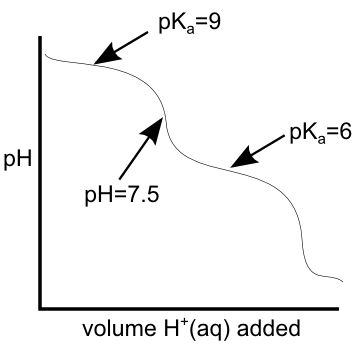
Between equivalence points, we have buffering regions of the titration curve... at the mid-point of this buffering region, the pH is equal to the pKa of the weak acid of the mixture. If we know the pKa (and therefore the pH) on either side of the equivalence point we're interested in, we can get a pretty reliable estimate of the pH of that equivalence point. On the titration curve below, if the pKas that bound the equivalence point are 6 and 9, the pH of the equivalence point should be right between them at pH = 7.5.

Keep an eye on the weather... Unless MSUM officially closes campus tomorrow, we will have class and the exam as planned. I'll be there at 7:30.

2014-03-29

Neutral salts

The conjugate of a strong acid or strong base is neutral. That's just something we tend to accept, memorize, and move on. But why? Those two words are a big part of the reason I'm a chemist.

Let's take a look at a strong acid and see if we can make sense of this. Of the typical strong acids, nitric is usually the weakest, and nitric is also the only one that might have a Ka listed in standard tables. The stronger strong acids have really useful Ka values listed in the tables like "large" or "strong"... I don't have a "large" button on my calculator, so let's just use nitric acid and we'll hopefully see why the other strong acids would follow the same trend if we had a value for their Ka.

The Ka for nitric acid is usually listed at around 25. That means the Kb for nitrate ions is:
That's a REALLY weak Kb, but we can go ahead and calculate the pH of a solution just like in any other situation. How about the problem: What is the expected pH of a 0.500M solution of sodium nitrate? {By the way, we could make similar arguments to show that the sodium ions don't affect the pH, but we'll save those for another day...} As with all good equilibrium problems, it's probably not a bad idea to start with a table:
Now we can set up the Kb expression and plug in the numbers we have:
We should be able to simplify that with some assumptions... Let's assume that "x" is much smaller than 0.500 and much larger than 10-7. That gets us the simplified expression:
Solving this expression, we get x = 1.41x10⁻⁸, which gives us a pOH = -log(1.41x10⁻⁸) = 7.85, and pH = 6.15. Hmm, that's not neutral, that's acidic. The whole point of this was to prove that nitrate was a neutral ion. This is a disaster.

BUT WAIT!

We made some assumptions. We didn't check our assumption after we solved for "x". This is why I always tell you to check assumptions... We assumed that "x" would be much smaller than 0.500, which it is, but we also assumed that "x" was much larger than 10-7, which it absolutely is not! So the assumptions we made were an oversimplification of the problem and that's where we entered the danger zone. Looking back at our Kb expression, we can only simplify it to:
That's still going to require the quadratic formula to solve. I'll let you work out the details, but the result should be that x = 7.96x10⁻⁹. That means:
[OH-1]eq = 10-7 + (7.96x10⁻⁹) = 1.08x10⁻⁷ M
pOH = -log(1.08x10⁻⁷) = 6.9667
pH = 14 - 6.9667 = 7.0333
That's not exactly 7.0000000000 neutral, but it's pretty darn close, especially if we're thinking about this in terms of selecting a visual acid-base indicator for a titration. 

2014-01-19

Quiz 2 Hint

Quiz 2 has a heat capacity problem, and the heat capacity value given in the problem is in units of "joules per (mole Kelvin)". Remember, for heat capacity problems, we're looking at changes in temperature. Whether it's Celsius or Kelvin, the ΔT is the same because 1 degree C and 1 K are exactly the same size. You can use either, but make sure you're doing everything in the right order. A temperature that changes from 3.45°C to 12.71°C is changing by:
ΔT = 12.71°C - 3.45°C = 9.26°C
If you prefer Kelvin, convert BOTH individual temperatures to K, THEN subtract:
ΔT = 285.86K - 276.60K = 9.26K
Other questions, let me know...

Quiz 1 questions...

I've gotten a few questions about Quiz 1. Here are a few hints...

Question 1: How many moles of nitrogen atoms are in a given mass of iron(III) nitrate?
Start with a balanced chemical formula. How many moles of N are in each mole of iron(III) nitrate? Use the mole ratio to get moles of N from the moles of iron(III) nitrate.

Question 2: How many moles of chlorine atoms are in a given volume of a given concentration vanadium(IV) chlorate solution?
This is almost the same as question 1, but you need to use concentration and volume to determine the moles of vanadium(IV) chlorate instead of mass and molar mass.

Two other helpful hints:
1. Don't wait until the day before a quiz is due to work on it. This is especially true because...
2. When you have a question, show me your work. If you have the problem all set up, it's much easier for me to look at what you've done and help you work through the problem correctly. It's always easier to help you when you can give me an idea of where you're getting confused.

2014-01-12

Spring Semester 2014 is here!

We're 18 hours away from the first Gen Chem II class of 2014! Watch this blog for general info about the topics we'll be exploring and answers to specific questions I get by email. I'll also be tweeting links and daily summaries using #GenChem2014. And I might try a few other things this semester…

A couple tips that are always useful:
1. If there's a way to calculate moles of a substance, that might be a good start.
2. Balance your chemical formulas. Then balance your chemical reactions. Balance is the key to chemistry. And skiing. If you don't balance your formulas and reactions, you're gonna have a bad time.
3. Be curious. That what science is all about.
4. Ask questions. Unless you're the only person in the room, it's pretty likely that someone else in the room has the same question you do.
5. Be bold. It's OK to answer a question incorrectly in class, we're learning chemistry here not juggling chainsaws. The other side of this is to be supportive of your classmates, we're all here to learn (including me).

Enjoy the beautiful weather today and I'll see you tomorrow.

2013-12-12

Email question 2013-12-12

------------------------------
Hello Dr. Bodwin. I've been working on some old exams for studying and on the exam 1a from fall 2011, the last question is asking about the empirical formula, and I was just wondering when solving for each part, where do the last two numbers come from?
For example,
C -> (71.98 g)/(12.011 g/mol) = 5.993 mols -> 4.5 -> 9
------------------------------

Let me pull up the whole problem from the exam key:

{from:  http://www.drbodwin.com/teaching/exams/c150fe1ak.pdf}

When determining empirical formulas from percent composition data, the first step is to assume that you have 100g of sample. You can assume any amount of sample you like, but 100g simplifies things a little because if I have 100g of a sample and I know that 71.98% of that sample is carbon, then there must be 71.98g of carbon in the sample. Using the percentages given in the problem, we know that the "100g" sample contains 71.98g of carbon, 6.711g of hydrogen, and 21.31g of oxygen. Grams are great, but we want to count the number of different atoms, so we need to convert grams to moles... That's the first step in the calculation that is shown.
Once we have moles, we know the relative amounts of each element present in the sample, and we can write a balanced chemical formula:
C5.993H6.658O1.332
Hmm, that doesn't look quite right... But at this point, we have the correct relationship between the moles of each element, so we can force those relationships to be whole numbers by dividing all of them by the smallest one. Essentially, we're saying "what if 1.332 actually represents 1 oxygen atom?" Dividing them all gives the forumla:
C4.5H5O1
Still not perfect, but it's a lot more "normal" looking than the first formula. Again, since we know that the relationship between moles is correct here, we can multiple all the subscripts by something that gives us a nice, round, whole number ratio. If we double everything, we get:
C9H10O2
And now we have a good empirical formula for this elemental analysis.

Other questions? Let me know.

2013-10-10

Problem Set 2

There's a key posted for the problem set we did in class that was titled "Problem Set #2" on my Gen Chem webpage:
http://www.drbodwin.com/teaching/genchem.php
Direct link to the key:  http://www.drbodwin.com/teaching/problemsets/c150gps02k.pdf

Don't forget, there are also old exams posted at:
http://www.drbodwin.com/teaching/examarchive.php

Other questions, let me know…

2013-09-13

Carbons in a propane sample

Today in class we looked at a problem that some of you didn't quite get to the end of by the time class ended. Here it is. If you haven't already worked it through, give it a good try before you jump ahead to the answer...

How many carbon atoms are in a 37.43L sample of propane gas at 17.52°C and 1.472atm?

This starts out as an Ideal Gas Law problem with a single set of conditions.
PV = nRT
Plugging in the values from the problem:
(1.472atm)(37.43L) = n(0.08206L.atm/mol.K)((17.52+273.15)K)
n = 2.3099mols of C3H8(g)
{NOTE: I'm in the middle of the problem, so I'm not rounding for significant figures yet, 
but it looks like 4 sig figs would be good at this point…}
Each propane molecule contains 3 carbon atoms, so each mole of propane molecules contains 3 moles of carbon atoms.
(2.3099mols C3H8) (3mols C/1mol C3H8) = 6.92974mols C
(6.92974mols C) (6.022x10²³ C atoms/mol C) = 4.173x1024 C atoms in the sample.

DISCLAIMER: This problem assumes that propane is behaving as an ideal gas under these conditions. There's a pretty good chance that it would not be ideal under these conditions, but for the purposes of this problem let's assume it is.

2013-08-26

Welcome to Fall 2013!

Welcome to the first day of Fall 2013 at MSUM!

 If you're looking for the textbook for class, here's the link on Amazon. http://www.amazon.com/Chemistry-Science-Context-Third-Edition/dp/0393934314/ref=sr_1_1?ie=UTF8&qid=1377519676&sr=8-1&keywords=chemistry+3rd+edition+gilbert
This is not an endorsement or recommendation of amazon.com, it's just the quickest way I could find a fairly universal link to the correct textbook. The book is available at the MSUM Bookstore and many other places.

2013-07-18

In-Class problems 2013-07-18

Today was buffers day in class so we looked at 294 different ways to use the Henderson-Hasselbalch equation. Remember, the Henderson-Hasselbalch equation is just a rearrangement of the Ka expression we use for understanding any acid... You can always plug directly into the Ka expression and get the same result you will get using Henderson-Hasselbalch. So the problems...

1. Combine 12.642g of chlorous acid with 15.372g of lithium chlorite, dilute to 500.0mL. What is the expected pH of this buffer? (Chlorous acid Ka = 1.12x10⁻²)
Plug into the Henderson-Hasselbalch equation...
And solve...

2. Prepare 500.0mL of a 0.650M HN3/N3-1 buffer at pH = 5.10 from HN3(s) and NaN3(s). (Hydrazoic acid Ka = 1.93x10⁻⁵)
Start off by solving for the ratio of conjugate acid to conjugate base using either the Henderson-Hasselbalch equation or just an unmodified Ka expression. I'll use H-H...
[N3-1] / [HN3] = 2.4297
[N3-1] = 2.4297[HN3]
Now that we know the ratio of these concentrations, we can solve for the actual concentrations by using the relationship...
0.650M = [HN3] + [N3-1]
0.650M = [HN3] + 2.4297[HN3] = 3.4297[HN3]
[HN3] = 0.1895M
[N3-1] = 0.650 – [HN3] = 0.650 – 0.1895 = 0.4605M
To make a solution that's 0.1895M HN3 at 500.0mL, we need...
(0.5000L)(0.1895M) = 0.09475mols HN3
(0.09475mols HN3)(43.029g/mol) = 4.077g HN3(s)
To make a solution that's 0.4605M N3-1 at 500.0mL, we need...
(0.5000L)(0.4605M) = 0.23025mols N3-1
(0.23025mols N3-1)(65.011g/mol) = 14.969g NaN3(s)
So we should be able to make the target buffer by combining 4.077grams of HN3 and 14.969g of NaN3 in enough water to make 500.0mL of solution.
NOTE: If you're actually making a buffer, be very careful about the order of addition of the components. Whenever you're combining a solid or concentrated solution with a solvent, it's usually a good practice to add the solid or concentrated stock to the larger volume of solvent slowly with very good mixing. Dissolving and/or mixing can liberate a LOT of heat in some cases that could be dangerous if the order of addition is reversed.
NOTE2: Hydrazoic acid is not a solid at room temperature, and the pure liquid is a non-trivial safety risk... We can talk about this type of a buffer on paper, but there's very little chance you (or I) will ever prepare or use a hydrazoic acid-based buffer.

3. What is Ka of a weak acid, “HA”, if a solution made by dissolving 0.316mol HA and 0.327mol A-1 in water and diluting to 750.0mL has a pH of 9.374?
Plug in to Henderson-Hasselbalch or the generic Ka expression...
9.374 = pKa + log (0.327 / 0.316)
pKa = 9.359
Ka = 4.374x10⁻¹⁰

4. What is Kb of a weak base, “B”, if a solution made by dissolving 0.143mol B and 0.158mol HB+1 in water and diluting to 400.0mL has a pH of 5.975?
Similar to the previous problem, plug in to Henderson-Hasselbalch or the generic Ka expression...
5.975 = pKa + log (0.143 / 0.158)
pKa = 6.018
pKb = 14 – 6.018 = 7.892
Ka = 1.043x10⁻⁸

Good luck.

2013-07-03

Rate Law and Integrated Rate Law Problem {2013-07-03}

Under some set of conditions, ammonia gas and fluorine gas react to form nitrogen trifluoride gas and hydrogen gas at 8.73ºC. What is the correct rate law expression (including the rate law constant) given the following data:
Rxn #
[NH3]0
[F2]0
Rate (M/min)
1
0.274
0.218
1.841x10⁻²
2
0.274
0.436
7.362x10⁻²
3
0.822
0.436
2.209x10⁻¹
The rate law expression for this reaction is:
Rate0 = k[NH3]0x [F2]0y
Comparing Rxn #1 and #2:
y = 2, the reaction is 2nd order with respect to fluorine concentration
Comparing Rxn #3 and #2:
x = 1, the reaction is 1st order w.r.t. ammonia concentration
Plugging in values from Rxn #1 and solving for k...
1.841x10⁻² M/min = k (0.274M)1 (0.218M)2
k = 1.42 M-2min-1

In Rxn #2, how much time must pass before [F2] = 0.324M?
Plugging in to the 2nd order integrated rate law expression...
t = 0.558 minutes

In Rxn #1, how much time must pass before [NH3] = 0.217M?
Plugging in to the 1st order integrated rate law expression...
t = 0.164 minutes


2013-07-02

Colligative properties and gas law problems 2013-07-02

1. 12.64g of sodium sulfate is dissolved in 400.0mL of water. What are the boiling point and freezing point of the solution?
Na2SO4 = 142.041g/mol
12.64g / 142.041g/mol = 0.0889884mols Na2SO4
{NOTE: don't round sig figs in the middle of a problem...}
(0.0889884mols Na2SO4) / 0.4000kg water = 0.22247m Na2SO4
{NOTE: density of water is 1.0000g/mL...}
ΔTbp = (0.512 ºC/m)(0.22247m)(3mol particles / 1mol Na2SO4) = 0.342ºC
{NOTE: I think I used a different value for the boiling point elevation constant in class. This one is correct.}
{NOTE: When Na2SO4 dissolves in water, the result is 2 Na+(aq) ions and 1 SO4-2(aq) ion. 3 particles.}
Tbp = 100.000ºC + 0.342ºC = 100.342ºC

ΔTfp = (1.858 ºC/m)(0.22247m)(3mol particles / 1mol Na2SO4) = 1.240ºC
Tfp = 0.000ºC – 1.240ºC = -1.240ºC

2. A weather balloon is filled with 23.65L of an ideal gas at 28.73ºC and 1.042atm pressure. It is released and rises to an altitude where the temperature is -6.35ºC the pressure is 0.842atm. How many moles of gas are in the balloon and what is its volume when it reaches the described altitude?
Plugging in to the Ideal Gas Law:
PV = nRT
(1.042atm)(23.65L) = n(0.08206 L.atm/mol.K)(301.88K)
n = 0.9948 moles
{NOTE: Convert to kelvins! If you pay attention to the units on R you'll be less likely to forget...}

Now that we know how many moles of gas are present, the next part could be solved by plugging in to the regular Ideal Gas Law again:
PV = nRT
(0.847atm)V = (0.9948mols)(0.08206 L.atm/mol.K)(266.80K)
V = 25.7L
Or by using the comparative form of the Ideal Gas Law:
P1V1/n1T1 = P2V2/n2T2
{NOTE: Since “n” is not changing, we can drop it from the equation...
(1.042atm)(23.65L) / 301.88K = (0.847atm)V2 / 266.80K
V2 = 25.7L


Practice, practice, practice...