Showing posts with label concentration. Show all posts

2014-03-30

Pre-Exam 3 email questions...

A few questions have come in by email, here they are:

----Question-----
I have a question regarding problem 9 on exam 3a from spring 2013. I understand that the calculated x value doesn't fit under the assumptions. I see where the first two values come from. I was wondering where the -1.238 x 10^-3 came from?

{(x)(x)} / (0.516 – x) = 2.40 x 10^-3
0.516 is the initial concentration and 2.40 x 10^-3 is Ka.
 x^2 + (2.40 x 10^-3)x + (-1.238 x 10^-3 ) = 0
----Answer-----
In order to use the quadratic formula, we have to solve the equation to the form:
ax2 + bx + c = 0
The (-1.238x10⁻³) term comes from (2.40x10⁻³)(0.516).


----Question-----
I was going through some of the old exams and the problems that use the Henderson - Hasselbalch. In those examples when it asked for the concentration of the conjugate base over the concentration of conjugate acid, but in the key only the moles of both are put in those places. Why? 
----Answer-----
This is a little mathematical shortcut. Since both the conjugate acid and conjugate base are in the same total volume of solution, the volumes mathematically cancel so I left them out. For example, if we had a buffer made from 0.65mols of HA and 0.55mols of A-1 in 800.0mL of buffer solution, that last part of the Henderson-Hasselbalch would look like:
You can always keep the volume in there and calculate the actual concentrations of each component, you should get exactly the same answer either way.


----Question-----
I dont understand how you can derive pH values from pka's given in the question. I also dont understand how pH can be calculated at each eq point in the titration curve as in number 11 on spring 2013 where it asks what indicator to use.. it says use the 2 pkas...how does this help?
----Answer-----
There are a couple ways that pKa (or pKb) can lead to a pH. One possibility is in a question like "What is the expected pH of a 0.618M solution of ammonium nitrate solution?" In this question, you can set up a Ka-type equilibrium for ammonium ions and use the Ka of ammonium to calculate [H3O+] and pH. This is similar to the problem I posted yesterday (http://chemistryingeneral.blogspot.com/2014/03/neutral-salts.html). This method can be used to calculate the initial pH for a titration. It would also work to approximate the pH of an equivalence point. Let's think about that...
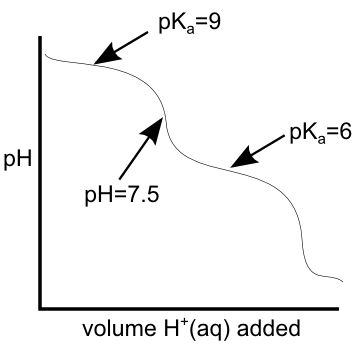
For the titration of phosphite ions with hydrochloric acid, we can calculate the initial pH by setting up a Kb-type equililbrium and using the Kb of phosphite ion to calculate [OH-1] and pOH and pH. At the first equivalence point in this titration, we have a solution that we can think of as HPO3-2(aq) because we have added just enough acid to complete the following equation exactly once:
PO3-3(aq) + H+(aq)  <=> HPO3-2(aq)
Between equivalence points, we have buffering regions of the titration curve... at the mid-point of this buffering region, the pH is equal to the pKa of the weak acid of the mixture. If we know the pKa (and therefore the pH) on either side of the equivalence point we're interested in, we can get a pretty reliable estimate of the pH of that equivalence point. On the titration curve below, if the pKas that bound the equivalence point are 6 and 9, the pH of the equivalence point should be right between them at pH = 7.5.
Keep an eye on the weather... Unless MSUM officially closes campus tomorrow, we will have class and the exam as planned. I'll be there at 7:30.

2014-01-19

Quiz 1 questions...

I've gotten a few questions about Quiz 1. Here are a few hints...

Question 1: How many moles of nitrogen atoms are in a given mass of iron(III) nitrate?
Start with a balanced chemical formula. How many moles of N are in each mole of iron(III) nitrate? Use the mole ratio to get moles of N from the moles of iron(III) nitrate.

Question 2: How many moles of chlorine atoms are in a given volume of a given concentration vanadium(IV) chlorate solution?
This is almost the same as question 1, but you need to use concentration and volume to determine the moles of vanadium(IV) chlorate instead of mass and molar mass.

Two other helpful hints:
1. Don't wait until the day before a quiz is due to work on it. This is especially true because...
2. When you have a question, show me your work. If you have the problem all set up, it's much easier for me to look at what you've done and help you work through the problem correctly. It's always easier to help you when you can give me an idea of where you're getting confused.

2013-10-10

Problem Set 2

There's a key posted for the problem set we did in class that was titled "Problem Set #2" on my Gen Chem webpage:
http://www.drbodwin.com/teaching/genchem.php
Direct link to the key:  http://www.drbodwin.com/teaching/problemsets/c150gps02k.pdf

Don't forget, there are also old exams posted at:
http://www.drbodwin.com/teaching/examarchive.php

Other questions, let me know…

2013-07-18

In-Class problems 2013-07-18

Today was buffers day in class so we looked at 294 different ways to use the Henderson-Hasselbalch equation. Remember, the Henderson-Hasselbalch equation is just a rearrangement of the Ka expression we use for understanding any acid... You can always plug directly into the Ka expression and get the same result you will get using Henderson-Hasselbalch. So the problems...

1. Combine 12.642g of chlorous acid with 15.372g of lithium chlorite, dilute to 500.0mL. What is the expected pH of this buffer? (Chlorous acid Ka = 1.12x10⁻²)
Plug into the Henderson-Hasselbalch equation...
And solve...

2. Prepare 500.0mL of a 0.650M HN3/N3-1 buffer at pH = 5.10 from HN3(s) and NaN3(s). (Hydrazoic acid Ka = 1.93x10⁻⁵)
Start off by solving for the ratio of conjugate acid to conjugate base using either the Henderson-Hasselbalch equation or just an unmodified Ka expression. I'll use H-H...
[N3-1] / [HN3] = 2.4297
[N3-1] = 2.4297[HN3]
Now that we know the ratio of these concentrations, we can solve for the actual concentrations by using the relationship...
0.650M = [HN3] + [N3-1]
0.650M = [HN3] + 2.4297[HN3] = 3.4297[HN3]
[HN3] = 0.1895M
[N3-1] = 0.650 – [HN3] = 0.650 – 0.1895 = 0.4605M
To make a solution that's 0.1895M HN3 at 500.0mL, we need...
(0.5000L)(0.1895M) = 0.09475mols HN3
(0.09475mols HN3)(43.029g/mol) = 4.077g HN3(s)
To make a solution that's 0.4605M N3-1 at 500.0mL, we need...
(0.5000L)(0.4605M) = 0.23025mols N3-1
(0.23025mols N3-1)(65.011g/mol) = 14.969g NaN3(s)
So we should be able to make the target buffer by combining 4.077grams of HN3 and 14.969g of NaN3 in enough water to make 500.0mL of solution.
NOTE: If you're actually making a buffer, be very careful about the order of addition of the components. Whenever you're combining a solid or concentrated solution with a solvent, it's usually a good practice to add the solid or concentrated stock to the larger volume of solvent slowly with very good mixing. Dissolving and/or mixing can liberate a LOT of heat in some cases that could be dangerous if the order of addition is reversed.
NOTE2: Hydrazoic acid is not a solid at room temperature, and the pure liquid is a non-trivial safety risk... We can talk about this type of a buffer on paper, but there's very little chance you (or I) will ever prepare or use a hydrazoic acid-based buffer.

3. What is Ka of a weak acid, “HA”, if a solution made by dissolving 0.316mol HA and 0.327mol A-1 in water and diluting to 750.0mL has a pH of 9.374?
Plug in to Henderson-Hasselbalch or the generic Ka expression...
9.374 = pKa + log (0.327 / 0.316)
pKa = 9.359
Ka = 4.374x10⁻¹⁰

4. What is Kb of a weak base, “B”, if a solution made by dissolving 0.143mol B and 0.158mol HB+1 in water and diluting to 400.0mL has a pH of 5.975?
Similar to the previous problem, plug in to Henderson-Hasselbalch or the generic Ka expression...
5.975 = pKa + log (0.143 / 0.158)
pKa = 6.018
pKb = 14 – 6.018 = 7.892
Ka = 1.043x10⁻⁸

Good luck.

2013-07-02

Colligative properties and gas law problems 2013-07-02

1. 12.64g of sodium sulfate is dissolved in 400.0mL of water. What are the boiling point and freezing point of the solution?
Na2SO4 = 142.041g/mol
12.64g / 142.041g/mol = 0.0889884mols Na2SO4
{NOTE: don't round sig figs in the middle of a problem...}
(0.0889884mols Na2SO4) / 0.4000kg water = 0.22247m Na2SO4
{NOTE: density of water is 1.0000g/mL...}
ΔTbp = (0.512 ºC/m)(0.22247m)(3mol particles / 1mol Na2SO4) = 0.342ºC
{NOTE: I think I used a different value for the boiling point elevation constant in class. This one is correct.}
{NOTE: When Na2SO4 dissolves in water, the result is 2 Na+(aq) ions and 1 SO4-2(aq) ion. 3 particles.}
Tbp = 100.000ºC + 0.342ºC = 100.342ºC

ΔTfp = (1.858 ºC/m)(0.22247m)(3mol particles / 1mol Na2SO4) = 1.240ºC
Tfp = 0.000ºC – 1.240ºC = -1.240ºC

2. A weather balloon is filled with 23.65L of an ideal gas at 28.73ºC and 1.042atm pressure. It is released and rises to an altitude where the temperature is -6.35ºC the pressure is 0.842atm. How many moles of gas are in the balloon and what is its volume when it reaches the described altitude?
Plugging in to the Ideal Gas Law:
PV = nRT
(1.042atm)(23.65L) = n(0.08206 L.atm/mol.K)(301.88K)
n = 0.9948 moles
{NOTE: Convert to kelvins! If you pay attention to the units on R you'll be less likely to forget...}

Now that we know how many moles of gas are present, the next part could be solved by plugging in to the regular Ideal Gas Law again:
PV = nRT
(0.847atm)V = (0.9948mols)(0.08206 L.atm/mol.K)(266.80K)
V = 25.7L
Or by using the comparative form of the Ideal Gas Law:
P1V1/n1T1 = P2V2/n2T2
{NOTE: Since “n” is not changing, we can drop it from the equation...
(1.042atm)(23.65L) / 301.88K = (0.847atm)V2 / 266.80K
V2 = 25.7L


Practice, practice, practice...

2013-02-23

Keeping track of concentrations


When doing kinetics and equilibrium problems, especially when you're doing an actual hands-on experiment, there are a lot of different concentrations to keep track of. The key to keeping them straight is mostly careful reading and organization, but there are a couple common definitions or descriptions that can help.
Stock Concentration
This is the one that comes up most common in a lab experiment. "Stock" refers to the large samples of reagent from which smaller amounts are taken for individual experiments. When you come to lab, the big bottles or carboys of solution that are on the side benches or in the dispensing hood are "stock" solutions and should have a "stock concentration" listed on the bottle. Most data analysis in lab begins with stock concentrations.
Initial Concentration
In either kinetics or equilibrium problems or experiments, we will often come upon something called an initial concentration. "Initial concentration" is (to me at least) quite fascinating because it's one of those things that we can do on paper that's just not physically possible to do in the real world. The "initial concentration" in a problem or experiment is the concentration of reactants after mixing everything together but before any reaction is allowed to take place. It's as if there was a little "start reaction" button on the side of the beaker, and nothing reacted until we pushed that button. In the real world, as soon as reactant solutions come in contact with each other, they begin to react, so the "initial concentration" is never the actual concentration we might observe in a reaction mixture. The initial concentration is most commonly calculated as a dilution of the stock concentration.
{In some specific reactions, we can probably observe an initial concentration because either the reaction is SO slow that we can mix the reactants before any measurable reaction has occurred, or because there's some external stimulus (like light or heat) required to make the reaction start. These reactions aren't that rare, but they're not reactions that we're likely to use very often in Gen Chem.}
Partial Pressures
When we're working with gases, we can often use Molarity to express the concentration of reactants, but we can also use partial pressures of the gaseous components. Partial pressures are a way to measure the number of moles of a specific gas in a mixture of gases. {Dalton's Law of Partial Pressures} That sounds an awful lot like a concentration... As with the vast majority of data analysis in chemistry, counting moles is the key to figuring out relationships between reacting species. If we know the concentration and volume of a liquid solution, we'll probably be calculating moles at some point. If we know the partial pressure of a gas, we'll probably also be calculating moles at some point. Chemistry is all about the mole!

The most important thing to do when approaching these problems is organization. This is especially true of equilibrium problems; if we can organize the information given in the problem, we'll be much more successful.

Did you hear about the chemist who was thinking very hard about removing excess solvent from a solution? She was concentrating.