Showing posts with label buffers. Show all posts

2014-04-01

More Email Questions...

A couple more email questions:

-----Question-----
On exam b spring 2011 #5 why should this be changed to Ka instead of Kb? Also on exam b spring 2010 #2 the 3rd line its says that HCl  works as an effective buffer. I thought an effective buffer had to be a weak conjugate acid/base?
-----Answer-----
Here's question #5
This is Ka because ammonium ion is a conjugate acid. You could also do this as a Kb equilibrium, but you'd be starting with products and shifting to the left to form reactants. Either way should give the same answer.

Here's #2:
Correct, an effective buffer is an approximately equimolar combination of a weak conjugate acid and its weak conjugate base. In the 3rd line here, HCl(aq) is protonating the carbonate in solution 1.5 times so the resulting mixture is 0.64mols HCO3-1(aq) and 0.64mols H2CO3(aq). This is an equimolar mixture of a weak acid and its conjugate base, so it should be a good buffer. {NOTE: because carbonic acid decomposes and the resulting CO2 can escape from solution, this might not be the best buffer in the real world, but it works fine as a sample problem.} This is similar to how you are making the carbonate buffer that you will measure in lab this week.

2014-03-30

Pre-Exam 3 email questions...

A few questions have come in by email, here they are:

----Question-----
I have a question regarding problem 9 on exam 3a from spring 2013. I understand that the calculated x value doesn't fit under the assumptions. I see where the first two values come from. I was wondering where the -1.238 x 10^-3 came from?

{(x)(x)} / (0.516 – x) = 2.40 x 10^-3
0.516 is the initial concentration and 2.40 x 10^-3 is Ka.
 x^2 + (2.40 x 10^-3)x + (-1.238 x 10^-3 ) = 0
----Answer-----
In order to use the quadratic formula, we have to solve the equation to the form:
ax2 + bx + c = 0
The (-1.238x10⁻³) term comes from (2.40x10⁻³)(0.516).


----Question-----
I was going through some of the old exams and the problems that use the Henderson - Hasselbalch. In those examples when it asked for the concentration of the conjugate base over the concentration of conjugate acid, but in the key only the moles of both are put in those places. Why? 
----Answer-----
This is a little mathematical shortcut. Since both the conjugate acid and conjugate base are in the same total volume of solution, the volumes mathematically cancel so I left them out. For example, if we had a buffer made from 0.65mols of HA and 0.55mols of A-1 in 800.0mL of buffer solution, that last part of the Henderson-Hasselbalch would look like:
You can always keep the volume in there and calculate the actual concentrations of each component, you should get exactly the same answer either way.


----Question-----
I dont understand how you can derive pH values from pka's given in the question. I also dont understand how pH can be calculated at each eq point in the titration curve as in number 11 on spring 2013 where it asks what indicator to use.. it says use the 2 pkas...how does this help?
----Answer-----
There are a couple ways that pKa (or pKb) can lead to a pH. One possibility is in a question like "What is the expected pH of a 0.618M solution of ammonium nitrate solution?" In this question, you can set up a Ka-type equilibrium for ammonium ions and use the Ka of ammonium to calculate [H3O+] and pH. This is similar to the problem I posted yesterday (http://chemistryingeneral.blogspot.com/2014/03/neutral-salts.html). This method can be used to calculate the initial pH for a titration. It would also work to approximate the pH of an equivalence point. Let's think about that...
For the titration of phosphite ions with hydrochloric acid, we can calculate the initial pH by setting up a Kb-type equililbrium and using the Kb of phosphite ion to calculate [OH-1] and pOH and pH. At the first equivalence point in this titration, we have a solution that we can think of as HPO3-2(aq) because we have added just enough acid to complete the following equation exactly once:
PO3-3(aq) + H+(aq)  <=> HPO3-2(aq)
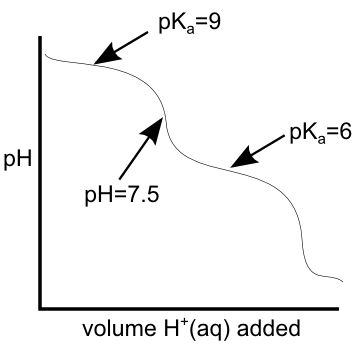
Between equivalence points, we have buffering regions of the titration curve... at the mid-point of this buffering region, the pH is equal to the pKa of the weak acid of the mixture. If we know the pKa (and therefore the pH) on either side of the equivalence point we're interested in, we can get a pretty reliable estimate of the pH of that equivalence point. On the titration curve below, if the pKas that bound the equivalence point are 6 and 9, the pH of the equivalence point should be right between them at pH = 7.5.

Keep an eye on the weather... Unless MSUM officially closes campus tomorrow, we will have class and the exam as planned. I'll be there at 7:30.

2013-07-18

In-Class problems 2013-07-18

Today was buffers day in class so we looked at 294 different ways to use the Henderson-Hasselbalch equation. Remember, the Henderson-Hasselbalch equation is just a rearrangement of the Ka expression we use for understanding any acid... You can always plug directly into the Ka expression and get the same result you will get using Henderson-Hasselbalch. So the problems...

1. Combine 12.642g of chlorous acid with 15.372g of lithium chlorite, dilute to 500.0mL. What is the expected pH of this buffer? (Chlorous acid Ka = 1.12x10⁻²)
Plug into the Henderson-Hasselbalch equation...
And solve...

2. Prepare 500.0mL of a 0.650M HN3/N3-1 buffer at pH = 5.10 from HN3(s) and NaN3(s). (Hydrazoic acid Ka = 1.93x10⁻⁵)
Start off by solving for the ratio of conjugate acid to conjugate base using either the Henderson-Hasselbalch equation or just an unmodified Ka expression. I'll use H-H...
[N3-1] / [HN3] = 2.4297
[N3-1] = 2.4297[HN3]
Now that we know the ratio of these concentrations, we can solve for the actual concentrations by using the relationship...
0.650M = [HN3] + [N3-1]
0.650M = [HN3] + 2.4297[HN3] = 3.4297[HN3]
[HN3] = 0.1895M
[N3-1] = 0.650 – [HN3] = 0.650 – 0.1895 = 0.4605M
To make a solution that's 0.1895M HN3 at 500.0mL, we need...
(0.5000L)(0.1895M) = 0.09475mols HN3
(0.09475mols HN3)(43.029g/mol) = 4.077g HN3(s)
To make a solution that's 0.4605M N3-1 at 500.0mL, we need...
(0.5000L)(0.4605M) = 0.23025mols N3-1
(0.23025mols N3-1)(65.011g/mol) = 14.969g NaN3(s)
So we should be able to make the target buffer by combining 4.077grams of HN3 and 14.969g of NaN3 in enough water to make 500.0mL of solution.
NOTE: If you're actually making a buffer, be very careful about the order of addition of the components. Whenever you're combining a solid or concentrated solution with a solvent, it's usually a good practice to add the solid or concentrated stock to the larger volume of solvent slowly with very good mixing. Dissolving and/or mixing can liberate a LOT of heat in some cases that could be dangerous if the order of addition is reversed.
NOTE2: Hydrazoic acid is not a solid at room temperature, and the pure liquid is a non-trivial safety risk... We can talk about this type of a buffer on paper, but there's very little chance you (or I) will ever prepare or use a hydrazoic acid-based buffer.

3. What is Ka of a weak acid, “HA”, if a solution made by dissolving 0.316mol HA and 0.327mol A-1 in water and diluting to 750.0mL has a pH of 9.374?
Plug in to Henderson-Hasselbalch or the generic Ka expression...
9.374 = pKa + log (0.327 / 0.316)
pKa = 9.359
Ka = 4.374x10⁻¹⁰

4. What is Kb of a weak base, “B”, if a solution made by dissolving 0.143mol B and 0.158mol HB+1 in water and diluting to 400.0mL has a pH of 5.975?
Similar to the previous problem, plug in to Henderson-Hasselbalch or the generic Ka expression...
5.975 = pKa + log (0.143 / 0.158)
pKa = 6.018
pKb = 14 – 6.018 = 7.892
Ka = 1.043x10⁻⁸

Good luck.

2013-04-04

What about that ratio in the Henderson-Hasselbalch equation?

A few people have asked about some buffer questions that use the Henderson-Hasselbalch equation. In the proper Henderson-Hasselbalch equation derived from Ka, the pH and pKa are related by "log of the concentration of conjugate base over concentration of conjugate acid". Great, that works. When we're actually using the H-H equation, we can get away with a little shortcut in the calculation BECAUSE we're talking about a single buffer solution that has some conjugate acid and some conjugate base. Here's an example from an old exam:

The set-up calls for concentration {implied by the square brackets}, but when I worked through the calculation, I used moles. THAT'S CHEATING!!!! Well, not really... If we wanted to convert both of those moles to molarity, we'd divide each of them by 0.5000L, and you can go ahead and do that if you like, BUT since we're dividing the numerator and the denominator by the same volume, those volumes cancel out (mathematically) and give the same ratio as when we use moles directly. Let's look at a simpler example of this using simple whole numbers so I don't have to find a calculator... Let's say we have 2 liters of buffer solution that contains 4 moles of conjugate base and 2 moles of conjugate acid. The concentration of conjugate base is (4moles/2L = 2M) and the concentration of conjugate acid is (2moles/2L = 1M), so the ratio of conjugate base concentration to conjugate acid concentration is (2M/1M = 2). If I just use moles, the ratio is (4moles/2moles = 2). Same ratio.
So when we're using the Henderson-Hasselbalch equation correctly for buffer calculations, we can often just use the ratio of moles rather than the ratio of concentrations because it gives the same answer.